

Medically reviewed by Dr. Bhimi Daimari, MBBS, MS (Obstetrics and Gynaecology) · Review date: 14 November 2026
You had sex around ovulation and now every twinge feels like a clue. Here is what is actually happening inside your body in the first three days, what you can and cannot feel yet, and when a pregnancy test can give you a real answer.
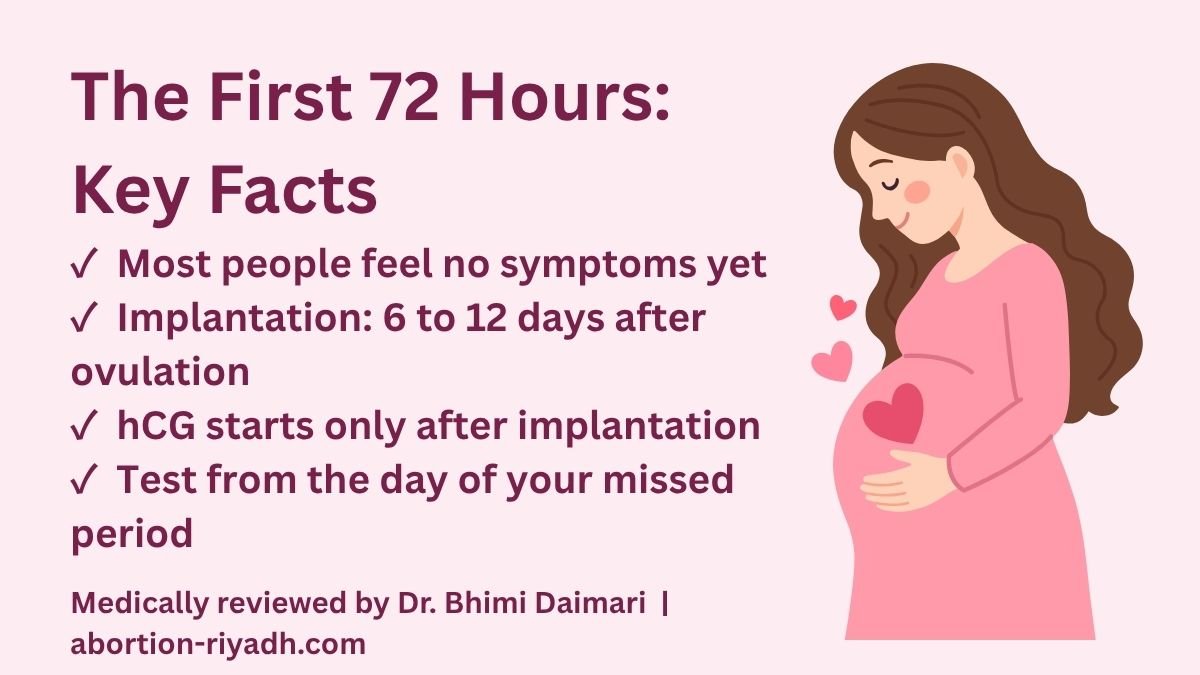
Quick answer: In the first 72 hours after conception, most people feel nothing at all. The fertilised egg is still travelling down the fallopian tube, it has not attached to the uterus, and your body is not yet making the pregnancy hormone hCG. Symptoms and a positive test come later, usually around the time of your missed period.
Can you have pregnancy symptoms in the first 72 hours?
In almost every case, no. Three days after conception, a pregnancy is a tiny cluster of cells floating inside the fallopian tube. It has not reached the uterus, it has not attached to your body, and it is not sending any hormone into your blood.
Pregnancy symptoms are caused by hormones, mainly human chorionic gonadotropin (hCG) and the rising progesterone and oestrogen that follow it. Your body starts making hCG only after the embryo implants in the lining of the uterus. That happens about 6 to 12 days after ovulation.
So if you feel cramps, tiredness or sore breasts in the first 72 hours, the feeling is real, but pregnancy is very unlikely to be the cause. The same sensations appear after ovulation in cycles where no egg was fertilised.
What “the first 72 hours” really means
People use this phrase in two ways, and the difference matters.
72 hours after sex. Sperm can survive inside the uterus and fallopian tubes for up to about five days. If you had sex before ovulation, fertilisation may not have happened yet at the 72-hour mark. You are not pregnant at this point, and you may never be from that act of sex.
72 hours after conception. An egg lives for roughly 12 to 24 hours after it leaves the ovary. If sperm reach it in that window, fertilisation happens in the fallopian tube. Three days later, the fertilised egg has divided into a small ball of cells and is still moving toward the uterus.
In both cases there is nothing yet for your body to respond to. Doctors do not even count a pregnancy as established until implantation is complete.
There is a third source of confusion. Doctors date pregnancy from the first day of your last period, not from conception. By that count, you are already called “two weeks pregnant” on the day you ovulate. So “week 1” and “week 2” of pregnancy happen before the egg is fertilised at all.
From fertilisation to implantation to the first hCG
Here is the sequence in simple steps. Days are counted from ovulation, often written as DPO (days past ovulation).
Days 0 to 1: fertilisation
A sperm enters the egg in the outer part of the fallopian tube. The genetic material from both joins to form a single cell called a zygote. You cannot feel this.
Days 2 to 4: travelling and dividing
The zygote divides into 2 cells, then 4, then 8, and keeps going. By about day 3 or 4 it is a solid ball of cells called a morula. Tiny hairs lining the tube move it slowly toward the uterus. This is where a pregnancy is during the first 72 hours.
Days 5 to 6: arriving in the uterus
The ball of cells becomes a blastocyst, a hollow structure with an inner group of cells that will form the embryo and an outer layer that will form the placenta. It floats in the uterus and sheds its outer shell.
Days 6 to 12: implantation
The blastocyst attaches to the uterine lining and gradually burrows in. In most pregnancies this happens 8 to 10 days after ovulation. Some people notice light spotting around this time. You can read more in our guide to implantation bleeding and when to test.
After implantation: hCG appears
Once the outer cells connect with your blood supply, they release hCG. The level starts very low and in early pregnancy roughly doubles every two to three days. Our page on hCG levels by week shows the typical ranges.
hCG tells the ovary to keep producing progesterone, which stops your period from coming. It is also the hormone that every pregnancy test looks for.
Days past ovulation: what is happening and can a test detect it?
The timings below are typical ranges. Your own cycle may run a day or two earlier or later, and many people do not know their exact ovulation day.
| Days past ovulation | What is happening | Can a test detect it? |
|---|---|---|
| 0 | The ovary releases an egg, which survives about 12 to 24 hours | No |
| 0 to 1 | Fertilisation in the fallopian tube | No |
| 2 to 4 | Cells divide while the embryo moves along the tube (the first 72 hours) | No, there is no hCG yet |
| 5 to 6 | The blastocyst reaches the uterus | No |
| 6 to 12 | Implantation, most often on days 8 to 10; hCG production begins | Usually not yet |
| 10 to 12 | hCG is rising in the blood and starting to reach the urine | A blood test may detect it; an early home test may show a faint line, but a negative is not reliable |
| 13 to 14 | Your period is due | Most home urine tests are reliable from the first day of a missed period |
| 21 or more | About one week after a missed period | Yes, in nearly all pregnancies |
What people report feeling, and the likelier cause
Search any forum and you will find people describing symptoms at 1, 2 or 3 days past ovulation. They are not imagining them. After ovulation, the empty follicle in the ovary (the corpus luteum) releases progesterone, and progesterone has strong effects of its own.
This happens in every cycle with ovulation, pregnant or not. It is also why premenstrual symptoms and early pregnancy symptoms overlap so much.
- Cramps or twinges: ovulation can cause one-sided pain for a day or two. Progesterone also slows the bowel, causing gas and bloating that feel like pelvic cramps. For cramps later on, see early pregnancy cramps.
- Spotting: a little pink or brown spotting can follow ovulation itself. Implantation spotting, when it happens, comes later, about 6 to 12 days after ovulation.
- Fatigue: progesterone has a mild sedating effect and raises your body temperature slightly, so tiredness in the second half of the cycle is common.
- Breast tenderness: progesterone and oestrogen cause fluid retention and swelling in breast tissue before a period too.
- Nausea, food aversions, strong sense of smell: these are linked to rising hCG and usually start weeks later, around week 4 to 6 of pregnancy counted from the last period.
- Discharge changes: mucus normally becomes thicker and creamier after ovulation. Our comparison of discharge before a period and in early pregnancy explains why it cannot confirm a pregnancy.
When do real pregnancy symptoms start?
For most people, the first sign is a missed period. Other symptoms tend to build over the following weeks as hCG climbs.
- Around implantation (days 6 to 12): possible light spotting or mild cramping. Many people have neither.
- Around the missed period (week 4): breast soreness that feels stronger than usual, tiredness, needing to pass urine more often.
- Weeks 5 to 6 and after: nausea with or without vomiting, food aversions, a heightened sense of smell, mood changes.
Some people have very few symptoms in the first weeks and still have a healthy pregnancy. Having no symptoms does not mean something is wrong, and having many does not prove you are pregnant. Only a test can tell you.
When to take a pregnancy test

Testing in the first 72 hours will always give a negative result, even if you have conceived. There is no hCG to find.
The most reliable time to use a home test is from the first day of your missed period. If your cycles are irregular or you do not know when your period is due, test at least 21 days after the last time you had unprotected sex.
Some tests are sold as “early result” tests and can pick up a pregnancy a few days before the period is due. A positive result at that stage is usually correct. A negative one is not dependable, because implantation may have happened late or hCG may still be too low.
To get the clearest result:
- Use the first urine of the morning if you are testing early, because it is more concentrated.
- Check the expiry date and follow the timing in the leaflet exactly. Our step-by-step guide on how to use a pregnancy test kit covers this.
- If the result is negative and your period still has not come, test again after two or three days.
- If you see a faint second line within the reading time, treat it as a likely positive and repeat the test. See what a faint line means.
A doctor can also order a blood hCG test, which can detect a pregnancy slightly earlier than a urine test and measures the exact level.
What you can do in the first 72 hours
You cannot find out yet whether you are pregnant, but there are still useful steps, depending on what you want.
If you do not want to be pregnant: emergency contraception works by delaying ovulation or preventing fertilisation, so timing matters. Some options can be used for up to five days after unprotected sex, and all of them work better the sooner they are used. Read about emergency contraception pills and speak to a doctor or pharmacist as soon as possible.
If you are hoping to be pregnant: carry on as normal. Doctors generally recommend a daily folic acid supplement before conception and through early pregnancy, so ask your doctor or pharmacist which supplement suits you. Avoid alcohol and smoking, and check with a doctor before starting any new medicine.
Either way: try not to read meaning into every sensation. Note the date of sex and the date your next period is due, and plan your test for that day.
Get urgent care if you have a positive test or a late period together with: severe pain low in your abdomen, especially on one side, pain at the tip of your shoulder, heavy vaginal bleeding, or dizziness or fainting. These can be signs of a pregnancy growing outside the uterus. Go to an emergency department or call your local emergency number (997 in Saudi Arabia, 911 in the US).
See a doctor without delay if your period is more than a week late with repeated negative tests, or if you have pelvic pain or unusual bleeding that worries you.
Frequently Asked Questions
Can you feel pregnant after 2 or 3 days?
It is very unlikely. At two or three days the fertilised egg is still in the fallopian tube and has no connection to your bloodstream, so it cannot cause symptoms. What you feel at this point is usually progesterone, which rises after every ovulation.
How soon after sex can pregnancy symptoms start?
For most people the earliest real symptoms start around the time of the missed period, roughly two weeks after conception. A few notice light spotting or mild cramps a little earlier, around implantation. Symptoms in the first few days after sex are not caused by pregnancy.
Can a pregnancy test be positive after 72 hours?
No. A test detects hCG, and hCG is only made after the embryo implants, which is at least six days after ovulation. A test taken at 72 hours will be negative whether or not you have conceived.
Is cramping 3 days after ovulation a sign of pregnancy?
Not usually. Cramping at 3 days past ovulation is too early for implantation, which rarely happens before day 6. It is more often linked to ovulation itself, bowel changes from progesterone, or gas and bloating.
Does your stomach feel different in the first days of pregnancy?
Some people feel bloated or heavy, but this comes from progesterone slowing the bowel, and it happens before a period too. The uterus itself does not change in a way you could feel during the first days. A visible bump is still many weeks away.
Can you feel the moment of conception or implantation?
You cannot feel fertilisation, because it involves two single cells. Some people report a brief pulling or mild cramping around implantation, but many feel nothing. There is no sensation that reliably tells you implantation has happened.
What does discharge look like right after conception?
In the days after ovulation, discharge normally turns thicker, creamy or sticky, and there is less of it. This is a progesterone effect and looks the same whether or not you conceived. Discharge alone cannot tell you if you are pregnant.
Why do I feel pregnant when the test is negative?
Progesterone after ovulation causes many of the same sensations as early pregnancy, and worry or hope can make you notice them more. You may also have tested too early for hCG to show. Repeat the test a few days later, or on the day your period is due.
Is it too late for emergency contraception after 72 hours?
Not necessarily. Some emergency contraception methods can be used for up to five days after unprotected sex, but they work better the sooner they are used. Speak to a doctor or pharmacist as early as you can.
Related guides
- Implantation bleeding and when to test
- Early pregnancy cramps: what is normal
- hCG levels by week
- Faint line on a pregnancy test
- Discharge before period vs early pregnancy
- False positive pregnancy test
- Can precum cause pregnancy?
Sources
- NHS – Signs and symptoms of pregnancy
- NHS – Doing a pregnancy test
- Mayo Clinic – Symptoms of pregnancy: What happens first
- ACOG – How Your Fetus Grows During Pregnancy
- Cleveland Clinic – Human Chorionic Gonadotropin (hCG)
- MedlinePlus – Pregnancy test
This page is general health information and does not replace advice from your own doctor. In an emergency, call your local emergency number (997 in Saudi Arabia, 911 in the US).