

Medically reviewed by Dr. Bhimi Daimari, MBBS, MS (Obstetrics and Gynaecology) · Review date: 5 November 2026
If you have had a blood pregnancy test, you may have been given an “hCG number” – and then searched online to find out if it is normal. hCG levels vary hugely from woman to woman, which can be confusing and worrying. In this guide we explain what hCG is, the usual ranges week by week, how fast it should rise, and what high or low numbers may mean.
Quick answer: hCG is the pregnancy hormone. Under 5 mIU/mL is negative and over 25 mIU/mL is usually positive. In early pregnancy, hCG often doubles every 48–72 hours and peaks around 8–11 weeks. Normal ranges are very wide, so the trend over time and the ultrasound matter more than a single number.
What Is hCG?
Human chorionic gonadotropin (hCG) is a hormone made by the cells that will form the placenta, soon after a fertilised egg implants in the womb. It is the hormone that home pregnancy tests detect in urine. A blood (beta-hCG) test measures the exact amount, in milli-international units per millilitre (mIU/mL). See also our guides to positive vs negative pregnancy test results and what a faint line on a pregnancy test means.
hCG Levels by Week: Typical Ranges
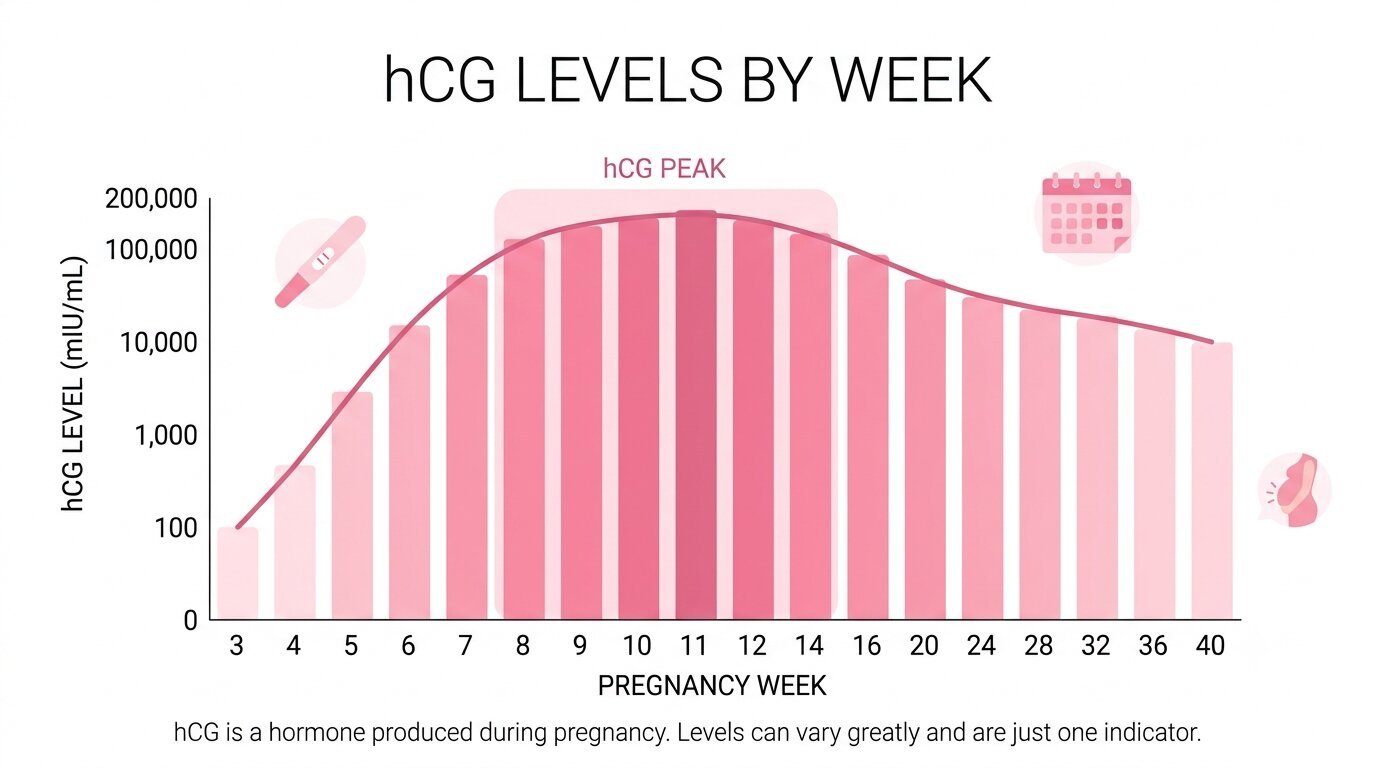
The table shows commonly used reference ranges, counted in weeks from the first day of your last menstrual period (LMP). Ranges differ between laboratories, and many healthy pregnancies fall outside them.
| Weeks since last period | Typical hCG range (mIU/mL) |
|---|---|
| 3 weeks | 5 – 50 |
| 4 weeks | 5 – 426 |
| 5 weeks | 18 – 7,340 |
| 6 weeks | 1,080 – 56,500 |
| 7 – 8 weeks | 7,650 – 229,000 |
| 9 – 12 weeks | 25,700 – 288,000 |
| 13 – 16 weeks | 13,300 – 254,000 |
| 17 – 24 weeks | 4,060 – 165,400 |
| 25 – 40 weeks | 3,640 – 117,000 |
Ranges as commonly published by the American Pregnancy Association. Your own laboratory’s ranges may differ.
Why One hCG Number Is Not Enough

Because the normal range is so wide – a healthy 5-week pregnancy can be 20 or 7,000 – a single result cannot tell you whether a pregnancy is healthy or how many weeks you are. Doctors use hCG together with:
- A repeat test after 48 hours to see the trend
- Ultrasound to see where the pregnancy is and whether it is developing
- Your symptoms and dates
How Fast Should hCG Rise? (Doubling Time)

In many healthy early pregnancies, hCG roughly doubles every 48 to 72 hours in the first weeks. The rise then slows as levels get higher. Clinical guidance notes that a smaller rise over 48 hours can still occur in some healthy pregnancies, so a slower rise is a reason to monitor closely rather than a diagnosis on its own (ACOG). hCG usually peaks around 8–11 weeks, then falls and levels off.
Video: Does hCG Have to Double Every 2 Days?
In this video, fertility specialist Dr. Randy Morris explains how hCG normally rises in early pregnancy and why the doubling rule is only a guide.
What Low or Slowly Rising hCG May Mean
- Your dates are earlier than you thought (common)
- A miscarriage – hCG may rise slowly, stay flat or fall. Read what a miscarriage looks like and miscarriage rates by week.
- An ectopic pregnancy – hCG often rises more slowly than usual. This is an emergency risk. Learn the signs of ectopic pregnancy.
What High hCG May Mean
- Your pregnancy is further along than you thought
- Twins or more (higher levels are common, but only ultrasound confirms)
- Rarely, a molar pregnancy, which needs medical follow-up
hCG and Ultrasound
Once hCG is high enough, a pregnancy should usually be visible inside the womb on a vaginal ultrasound. If hCG is above this level but no pregnancy is seen in the womb, doctors will check carefully for an ectopic pregnancy. Until the location is clear, this is called a pregnancy of unknown location. This is why hCG results are always read together with a scan.
When to Get Medical Help
Whatever your hCG level, go to the emergency department or call 997 in Saudi Arabia if you have severe or one-sided tummy pain, heavy bleeding, shoulder-tip pain, or feel faint. For non-urgent advice, call the Ministry of Health on 937. Also read our guide to early pregnancy cramps.
Related: Implantation bleeding: when will a pregnancy test be positive? explains when hCG starts to rise.
If hCG rises enough to give a positive test and then falls before anything can be seen on a scan, doctors call it a chemical pregnancy.
Frequently Asked Questions
What is a normal hCG level at 4 weeks pregnant?
At 4 weeks from the last period, hCG is often between about 5 and 426 mIU/mL. The range is wide, so one number on its own does not show whether a pregnancy is healthy.
What hCG level confirms pregnancy?
A blood hCG level above 25 mIU/mL is generally considered positive for pregnancy. A level under 5 mIU/mL is considered negative. Levels in between may need a repeat test.
How fast should hCG rise in early pregnancy?
In many healthy early pregnancies, hCG roughly doubles every 48 to 72 hours. A slower rise can still be normal in some cases, so doctors look at the trend together with ultrasound.
When does hCG peak in pregnancy?
hCG usually peaks around 8 to 11 weeks of pregnancy and then falls and levels off for the rest of the pregnancy.
Can low hCG mean miscarriage or ectopic pregnancy?
Low or slowly rising hCG can be a sign of miscarriage or ectopic pregnancy, but it can also be normal, especially if your dates are uncertain. Your doctor will repeat the test and use ultrasound to find out.
Do high hCG levels mean twins?
Twin pregnancies often have higher hCG levels, but a high number alone cannot confirm twins. Only an ultrasound can.
Sources
- American Pregnancy Association – hCG Levels
- ACOG Practice Bulletin 193 – Tubal Ectopic Pregnancy
- NICE NG126 – Ectopic pregnancy and miscarriage: diagnosis and initial management
Medical disclaimer: This article is for general education only. It does not replace advice, diagnosis or treatment from a qualified doctor.