

Intraduction
- A miscarriage usually looks like vaginal bleeding that can range from light spotting to heavy bleeding, often with clots and pregnancy tissue.
- Early on (4–5 weeks) it can look like a heavy period. Later (6–12 weeks) the clots and tissue are usually larger.
- Most women also have cramps or lower back pain.
- Some miscarriages have no bleeding at all. This is called a missed or silent miscarriage.
- Bleeding in pregnancy does not always mean a miscarriage. Only a doctor can confirm it, usually with an ultrasound.
What does a miscarriage look like?
A miscarriage is the loss of a pregnancy before 20 weeks. Doctors also call it a spontaneous abortion. You can read about all the medical types in our guide to types of abortion.
When a miscarriage happens, the body passes blood and pregnancy tissue through the vagina. What you see can include:
- Blood: from light pink or brown spotting to bright red, heavy bleeding
- Clots: dark red, jelly-like lumps, which may be small or as big as a grape or larger
- Tissue: grey, white or pinkish material that looks different from a normal clot
- A pregnancy sac: sometimes a small, clear or greyish sac filled with fluid, especially after 6 weeks
Because the blood and tissue may stay in the womb for some time before passing, they can look dark brown instead of bright red. This is common and not a sign of infection on its own.
What does a miscarriage look like week by week?
How a miscarriage looks depends mostly on how far along the pregnancy was.
At 2–4 weeks
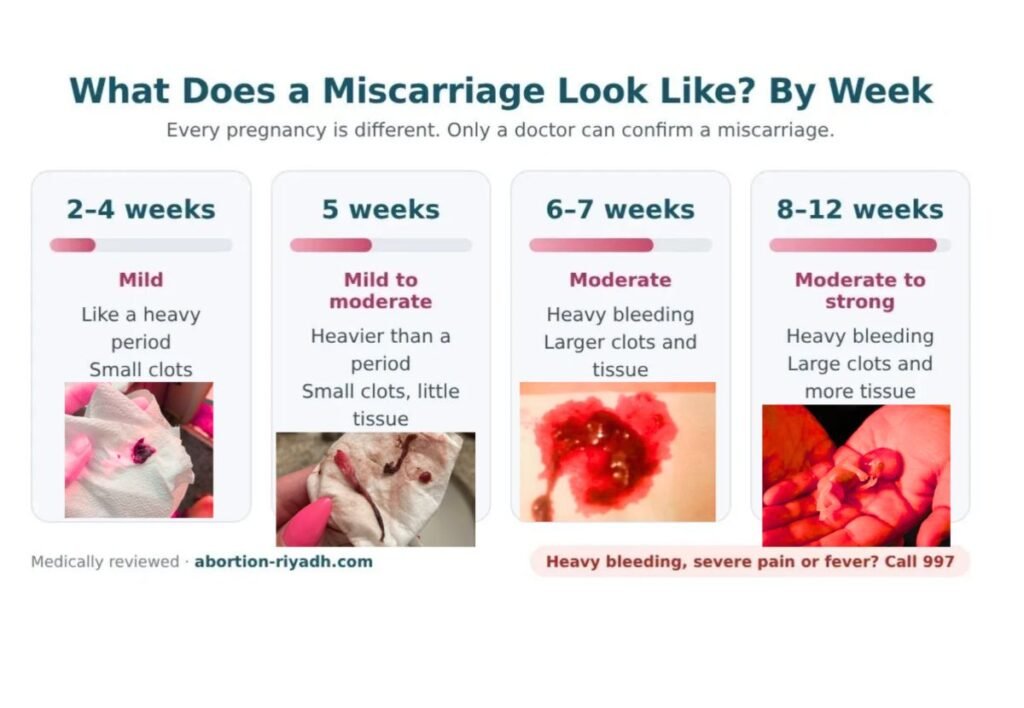
Very early losses (sometimes called a chemical pregnancy) often look like a normal or slightly heavier period, maybe a few days late. Many women do not know they were pregnant. You may see small clots, but tissue is usually not visible.
At 5 weeks
Bleeding is usually heavier than a normal period, with cramps and small clots. Tissue may be hard to tell apart from clots.
At 6–7 weeks
Bleeding and cramps are stronger. You may see larger clots and grey or pinkish tissue, and sometimes a small fluid-filled sac.
At 8–12 weeks
There is usually heavy bleeding with large clots and more tissue. Cramps can be strong, like period pain or mild labour pains. At this stage, many women are advised to have medical support.
Table: miscarriage by week
| Weeks pregnant | Bleeding | What you may see | Cramps |
|---|---|---|---|
| 2–4 weeks | Like a heavy period | Small clots | Mild |
| 5 weeks | Heavier than a period | Small clots, little tissue | Mild to moderate |
| 6–7 weeks | Heavy | Larger clots, grey or pink tissue, small sac | Moderate |
| 8–12 weeks | Heavy | Large clots and more tissue | Moderate to strong |
Signs a miscarriage may be starting
Common early signs include:
- Vaginal bleeding or spotting, which may start light and get heavier
- Cramping in the lower belly, like period pain
- Lower back pain
- Passing clots or tissue
- Pregnancy symptoms suddenly fading, such as less nausea or breast tenderness
Light bleeding with a closed cervix and a living pregnancy is called a threatened abortion, and many of these pregnancies continue. If the cervix opens and the loss cannot be stopped, it is called an inevitable abortion.
What does a miscarriage feel like?
Every woman is different. Many describe:
- Cramps like strong period pain that come and go in waves
- Pressure or heaviness in the pelvis
- Lower back ache
- A feeling of something passing when a clot or tissue comes out
- Tiredness, and emotional shock or sadness
The pain usually eases once the tissue has passed.
Miscarriage vs period: how to tell the difference
| Normal period | Early miscarriage | |
|---|---|---|
| Timing | When expected | Often late, after a positive test |
| Amount | Usual for you | Usually heavier |
| Clots | Small, few | More, and larger |
| Tissue | No | Grey or pink tissue may be seen |
| Cramps | Usual for you | Often stronger |
| Pregnancy test | Negative | Positive, then slowly becomes negative |
If you had a positive pregnancy test, any heavy bleeding should be checked by a doctor. Learn how to read a pregnancy test correctly.
What can be mistaken for a miscarriage?
Not all bleeding in early pregnancy is a miscarriage. Other causes include:
- Implantation bleeding: light spotting around the time of your expected period
- Bleeding from the cervix: for example after sex or an internal exam, because the cervix is more sensitive in pregnancy
- A subchorionic haematoma: a small collection of blood next to the pregnancy, which often settles by itself
- Ectopic pregnancy: bleeding with one-sided pain, sometimes shoulder-tip pain. This is an emergency. Read about ectopic pregnancy.
- A late, heavy period in someone who was not pregnant
That is why an ultrasound and pregnancy hormone (hCG) blood tests are important before a doctor confirms a miscarriage.
What is a silent miscarriage?
A silent (missed) miscarriage is when the pregnancy has stopped growing but there is no bleeding or pain. The first signs may only be pregnancy symptoms fading or a little brown spotting. It is usually found on a routine scan. Read our full guide to missed abortion (silent miscarriage).
How long can a missed miscarriage stay inside you? It can stay for days to several weeks before the body passes it. Many women choose medicine or a short procedure instead of waiting.
How long does a miscarriage last?
- The heaviest bleeding and cramps usually last a few hours, while the tissue passes.
- Lighter bleeding can continue for 1–2 weeks.
- Passing everything naturally can take days to a few weeks, which is why doctors plan a follow-up.
If bleeding lasts longer than 2 weeks, or gets heavier again, see your doctor. Some tissue may still be inside, which is called an incomplete abortion.
How is a miscarriage confirmed?
A doctor will usually:
- Ask about your bleeding, pain and dates.
- Do a transvaginal ultrasound to look at the womb.
- Check hCG blood levels, sometimes twice, 48 hours apart.
- Check your blood group, because some women need an extra injection after a loss.
If you pass tissue at home, your doctor may ask you to bring it in a clean container for testing.
When to get urgent help
Go to the emergency department or call 997 if you have:
- bleeding that soaks 2 large pads an hour for 2 hours in a row
- severe pain, especially on one side, or pain in the shoulder tip
- fever, chills or bad-smelling discharge (signs of infection)
- dizziness, fainting or a fast heartbeat
After a miscarriage
- Your period usually returns in 4–6 weeks. See period after abortion or miscarriage.
- Feelings: grief, guilt and sadness are normal, even after a very early loss. A miscarriage is not your fault. See emotional health after pregnancy loss.
- Trying again: most women go on to have a healthy pregnancy. Read pregnancy after a loss.
Getting care in Saudi Arabia
If you are pregnant and bleeding, see a gynaecologist at a Ministry of Health hospital or a licensed clinic. Call 937 for medical advice, or 997 in an emergency. For more, visit our complete medical guide.
Related: Want to know why it happens? Read what causes miscarriage – the common causes, risk factors and myths.
Want to know how the risk changes each week? Read our guide to miscarriage rates by week.
Bleeding with grape-like tissue or very severe nausea can rarely be a molar pregnancy – read how it is diagnosed.
Frequently Asked Questions
How can I tell if a miscarriage is starting?
The most common signs are bleeding or spotting with cramps or lower back pain. Only an ultrasound can confirm it, so see a doctor.
What are the first signs of a silent miscarriage?
Often there are none. Some women notice pregnancy symptoms fading or light brown spotting. It is usually found on a routine scan.
What is mistaken for a miscarriage?
Implantation bleeding, bleeding from the cervix, a small blood collection next to the pregnancy, a heavy late period, and ectopic pregnancy can all look similar.
How many days does it take to fully miscarry?
The heaviest part usually passes within hours, but bleeding can continue for 1–2 weeks. Passing everything naturally can take days to a few weeks.
What does a miscarriage look like at 6 weeks?
Usually heavy bleeding with larger clots, and sometimes grey or pinkish tissue or a small fluid-filled sac.
What does miscarriage tissue look like?
It often looks grey, white or pinkish and firmer than a blood clot. A small sac may be seen after about 6 weeks.
How long can a missed miscarriage stay inside you?
From days to several weeks. A doctor can offer medicine or a short procedure if you do not want to wait.
References
- NHS – Miscarriage
- ACOG – Early Pregnancy Loss
- Tommy’s – Miscarriage symptoms
- StatPearls – Early Pregnancy Loss (NCBI)
Medically reviewed by Dr. Bhimi Daimari, MBBS, MS (Obstetrics & Gynaecology) · Reg. No. 23218 · Published: November 2026
Medical disclaimer: This article is for general education only and is not a substitute for advice from a qualified doctor. If you have heavy bleeding, severe pain or fever, call 997.