
Medically reviewed by Dr. Bhimi Daimari, MBBS, MS (Obstetrics and Gynaecology) · Review date: 14 November 2026
If you had sex without a condom and your partner pulled out, or did not ejaculate at all, you may be wondering whether pregnancy is still possible. Here is what the evidence says, what you can do in the next few days, and when a test will give you a clear answer.
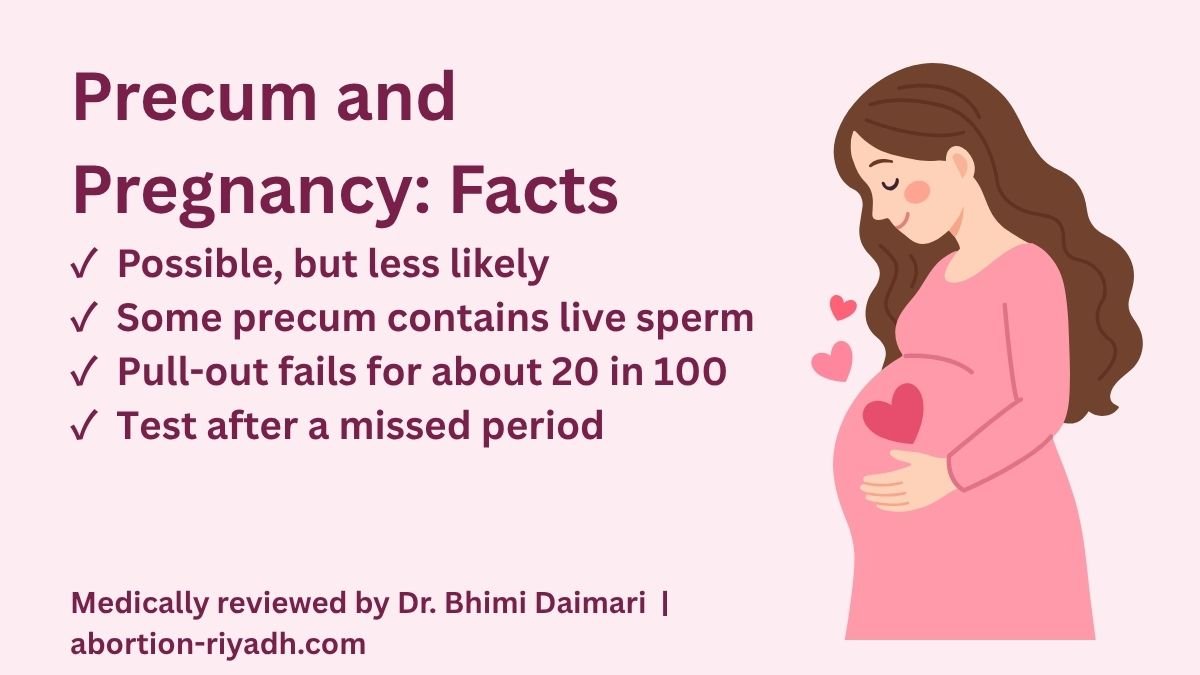
Quick answer: Pregnancy from precum is possible but less likely than from ejaculation. Some men have live sperm in their pre-ejaculate. If you want to avoid pregnancy, emergency contraception works best when used as early as possible, within 3 to 5 days.
Can precum cause pregnancy?

Yes, it is possible, but the chance is lower than with full ejaculation inside the vagina. Pre-ejaculate (precum) is not meant to carry sperm, yet studies have found live, moving sperm in the pre-ejaculate of some men. One sperm reaching an egg is enough.
That is why the withdrawal or “pull-out” method fails more often than most people expect, and why doctors do not describe sex without ejaculation as safe from pregnancy.
If this has just happened to you, two facts matter most. Emergency contraception works best the sooner you use it, and a pregnancy test cannot give you an answer for about two to three weeks. Both are explained below.
What is precum, and does it contain sperm?
Pre-ejaculate is a clear, slippery fluid released from the penis during arousal, before ejaculation. It is made by two small glands near the base of the penis, the Cowper’s (bulbourethral) glands. Its job is to lubricate and to neutralise traces of acidic urine in the urethra. It is released without any sensation or control, so a man cannot feel it or hold it back.
The fluid does not come from the testicles, and as it leaves the glands it contains no sperm. Sperm can get into it in two ways: a small amount may leak into the urethra before ejaculation, or sperm may be left in the urethra from an earlier ejaculation.
The research is limited and the studies are small, so the results should be read with care:
- A 2011 study in the journal Human Fertility examined pre-ejaculate samples from 27 men. Sperm were present in the samples of 11 of them (41%), and in most of those cases a reasonable share of the sperm were moving.
- A later study of healthy men found sperm in the pre-ejaculate of a smaller share, around 1 in 6.
- Some older, very small studies found no sperm or only a few that were not moving.
Taken together, the evidence suggests that some men regularly have sperm in their pre-ejaculate and others do not, and there is no way to tell which group a partner is in. Where sperm are found, the numbers are far lower than in semen, which is why the risk is lower. It is not zero.
You may have heard that passing urine before sex flushes sperm out of the urethra. It is a reasonable idea, but it has not been shown to prevent pregnancy, so do not rely on it.
How often does the withdrawal method fail?
The best evidence about real-life risk comes from couples who use withdrawal as their contraception.
- Typical use: about 20 out of 100 women who rely on withdrawal become pregnant within a year. The CDC gives a figure of 20% and ACOG about 22 in 100.
- Perfect use: if the man withdraws completely and in time on every occasion, the estimate is about 4 in 100 per year.
Most failures happen because withdrawal is late or incomplete, or because semen lands on the vulva. Sperm in pre-ejaculate probably accounts for part of the pregnancies that occur even with perfect timing.
For comparison, the pill has a typical-use failure of about 7 in 100 per year, and IUDs and implants fewer than 1 in 100. Withdrawal is better than no method at all. If avoiding pregnancy matters to you, a more reliable method is worth considering, and our overview of birth control pills is one place to start. Withdrawal also gives no protection against sexually transmitted infections, some of which can be passed on through pre-ejaculate. Condoms protect against both.
Does it matter where you are in your cycle?
Yes. Pregnancy can only happen if sperm are present during the fertile window. This is roughly six days long: the five days before ovulation and the day of ovulation itself. Sperm can survive in the uterus and tubes for up to five days, and the egg lives for about a day.
In a regular 28-day cycle, ovulation happens around day 14, counting from the first day of your period. So the chance of pregnancy from any unprotected sex is highest from about day 9 to day 15, and low just before and during a period.
The problem is that ovulation is hard to predict. It can come earlier or later than usual from one month to the next, even in regular cycles, and stress, illness and travel can shift it. With irregular cycles, guessing is less reliable still. A “safe day” on a calendar is an estimate, so it should not be the reason to skip emergency contraception when you want to avoid pregnancy.
Emergency contraception: your options
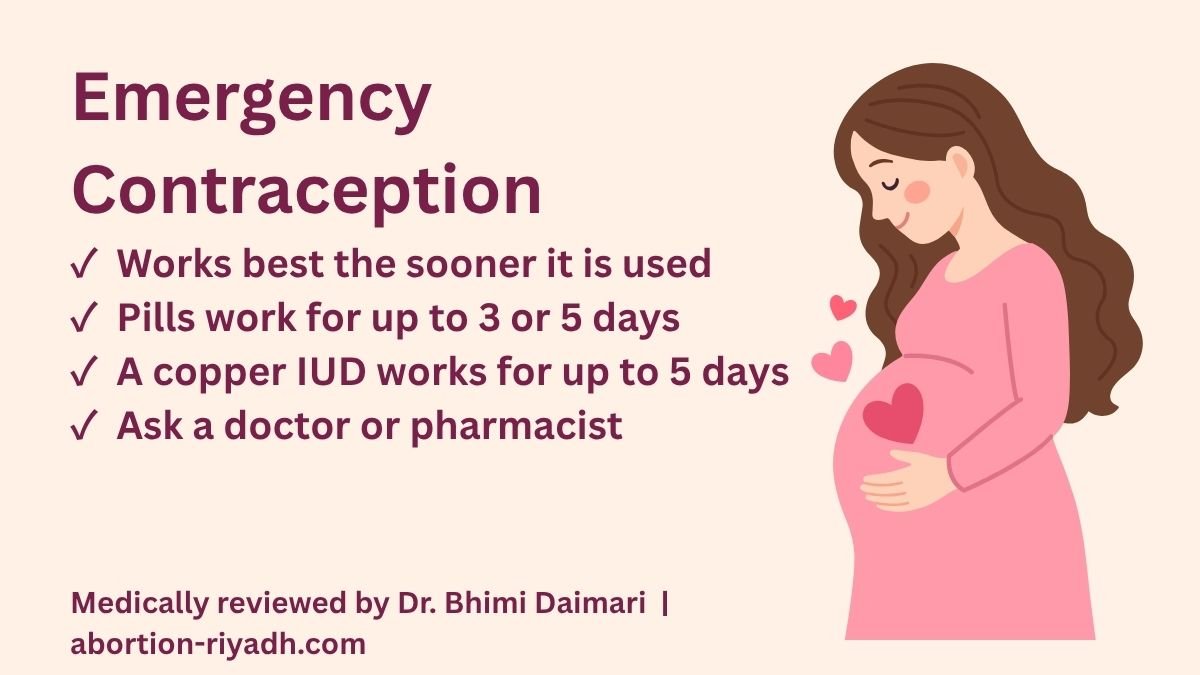
Emergency contraception (EC) lowers the chance of pregnancy after unprotected sex, including sex where withdrawal was used. WHO states that it can be used up to five days after sex, and that it works better the earlier it is used. There are two main kinds.
| Option | Time window after sex | What to know |
|---|---|---|
| Levonorgestrel emergency pill | As soon as possible; licensed for up to 72 hours (3 days) | Most effective in the first day and less so with each day. Mainly works by delaying ovulation. |
| Ulipristal acetate emergency pill | As soon as possible; up to 120 hours (5 days) | Remains effective later in the window than levonorgestrel. Availability varies by country, and it interacts with some hormonal contraceptives. |
| Copper IUD | Up to 5 days (120 hours) | The most effective option, preventing more than 99% of pregnancies. A doctor fits it, and it can stay in place as ongoing contraception. |
A few points apply to all of them:
- Emergency pills work mainly by delaying or preventing ovulation. They do not end a pregnancy that has already implanted and are not abortion pills.
- The pills may be less effective at higher body weight. If that applies to you, ask whether an IUD or a different pill is the better choice.
- If you vomit soon after taking a pill, ask a pharmacist or doctor whether it needs to be repeated.
- Emergency pills are not designed for regular use. They are less effective than ongoing contraception.
- Some guidelines now also include a hormonal IUD as an emergency option. Your doctor can tell you what is offered where you live.
Which methods are available, and whether you need a prescription, depends on the country. A doctor or pharmacist can advise on the right option for you and on the correct way to take it. Our pages on emergency contraception pills in Saudi Arabia and emergency contraception side effects go into more detail.
When to take a pregnancy test
A test taken in the first days after sex will be negative whatever the outcome. If an egg is fertilised, it takes about 6 to 12 days after ovulation to implant, and only then does the body start making the pregnancy hormone hCG. Symptoms in that first week are not from pregnancy, as we explain in first 72 hours of pregnancy symptoms.
- Test on the first day of a missed period, or
- if your cycles are irregular or you are unsure, test 21 days after the sex in question.
If you took an emergency pill, your next period may come a few days early or late. Test if it is more than seven days late, or if it is much lighter than usual.
Use the first urine of the morning and follow the timing on the leaflet. Our guide on how to use a pregnancy test kit shows the steps, and faint line on a pregnancy test explains unclear results. A negative test at 21 days is very reliable.
Light spotting about a week or more after sex can be an early period, a side effect of an emergency pill or, less often, implantation. See implantation bleeding and when to test for how to tell them apart.
When to see a doctor
Contact a doctor or pharmacist as soon as you can if you had unprotected sex within the last five days and do not want to become pregnant. The time window is the one thing you cannot get back.
Make an appointment as well if:
- your test is positive, so the pregnancy can be dated and you can discuss your next steps;
- your period is more than a week late and tests stay negative;
- you would like a more dependable contraceptive method;
- you are worried about a sexually transmitted infection, or the sex was not something you agreed to. Care and support are available, and you will not be judged for asking.
Call your local emergency number (997 in Saudi Arabia, 911 in the US) or go to an emergency department if you could be pregnant, or took emergency contraception in the past few weeks, and you develop severe pain low in the belly (especially on one side), shoulder-tip pain, dizziness or fainting, or very heavy vaginal bleeding. These can be signs of an ectopic pregnancy, which needs urgent treatment.
Worrying after a risk like this is very common, and it does not mean you did something wrong. Act on the parts you can control, which are emergency contraception now and a test at the right time, and the uncertainty will be over within a few weeks.
Frequently Asked Questions
What are the chances of getting pregnant from precum?
Nobody can give an exact figure for a single act, because it depends on whether sperm are present and where you are in your cycle. The chance is lower than with ejaculation but real. Among couples who rely on withdrawal, about 20 in 100 have a pregnancy within a year.
Can you get pregnant from precum if you are not ovulating?
Pregnancy needs sperm to be present in the days leading up to ovulation or on the day itself. Outside that window the chance is very low. The difficulty is that ovulation can shift, so you cannot be certain you were outside it.
Can precum on fingers or the outside of the vagina cause pregnancy?
It is very unlikely. Sperm need to get into the vagina and travel through the cervix, and they do not survive long once fluid dries on skin. A risk exists only if fresh fluid containing sperm is carried directly into the vagina.
Can you get pregnant from precum during your period?
The chance is low, because ovulation is usually many days away. It is not zero if your cycles are short or your bleeding is long, since sperm can live for up to five days. Bleeding in the middle of a cycle can also be mistaken for a period.
Does peeing before sex remove sperm from precum?
Urinating may wash out sperm left in the urethra from an earlier ejaculation, which is why it is often suggested. It has not been proven to lower the chance of pregnancy. Treat it as a small extra, not as protection.
Is the pull-out method safe if he pulls out every time?
Even with perfect timing every time, about 4 in 100 women become pregnant in a year. In everyday use the figure is about 20 in 100. It also offers no protection against sexually transmitted infections.
Should I take the morning-after pill for precum?
If you do not want to become pregnant and had sex without a reliable method in the last five days, emergency contraception is a reasonable choice. It works best when taken as early as possible. A pharmacist or doctor can advise on the right type for you.
How soon will I know if I am pregnant from precum?
A home test is reliable from the first day of a missed period, or 21 days after the sex. Testing sooner often gives a false negative. Early symptoms are not a trustworthy guide, because they overlap with premenstrual symptoms.
Does precum always contain sperm?
No. The fluid itself is made by glands that do not produce sperm. In studies, some men had sperm in their pre-ejaculate and many did not, and a man has no way of knowing which applies to him.
Can precum transmit infections?
Yes. Infections such as HIV, chlamydia and gonorrhoea can be passed on through pre-ejaculate and skin contact, even without ejaculation. Condoms used from the start of sex reduce this risk, and testing is available if you are worried.
Related guides
- Emergency contraception pills in Saudi Arabia
- Emergency contraception pills: side effects
- Birth control pills
- First 72 hours of pregnancy symptoms
- How to use a pregnancy test kit
- False positive pregnancy test
- Positive vs negative pregnancy test results
Sources
- Killick SR et al. – Sperm content of pre-ejaculatory fluid (Human Fertility, 2011)
- CDC – Contraception and birth control methods
- ACOG – Emergency Contraception
- WHO – Emergency contraception (fact sheet)
- NHS – Emergency contraception
- Mayo Clinic – Withdrawal method (coitus interruptus)
This page is general health information and does not replace advice from your own doctor. In an emergency, call your local emergency number (997 in Saudi Arabia, 911 in the US).