

Medically reviewed by Dr. Bhimi Daimari, MBBS, MS (Obstetrics and Gynaecology) · Review date: 14 November 2026
A positive pregnancy test you did not expect, or one that is followed by a negative, raises an obvious question: can the test be wrong? It can, but not often. Here is how to work out what your result means and what to do next.
Quick answer: True false positives are uncommon. A home test reacts to the hormone hCG, so a clear positive nearly always means hCG is in your body. The usual explanations are a very early pregnancy loss, hCG left over from a recent pregnancy or fertility injection, or a misread test. A repeat test and a blood hCG test will sort it out.
Can a pregnancy test be falsely positive?
Yes, but it is uncommon. Most home pregnancy tests state that they are about 99% accurate when you use them from the day your period is due and follow the instructions. In everyday use the accuracy is somewhat lower, and nearly all of that gap comes from missed pregnancies, not from false positives.
It helps to separate two situations that both get called a “false positive”:
- The test found hCG, and it was really there. You had a positive result but there is no ongoing pregnancy. The test worked. The hCG came from a very early loss, a recent pregnancy or an injection.
- There was no hCG, and the test was misread or faulty. This is a true false positive. It is the rarer of the two.
Knowing which one applies to you tells you what to do next.
How a home pregnancy test works
After an embryo implants in the uterus, the cells that will become the placenta start to make human chorionic gonadotropin (hCG). The hormone passes into your blood and then your urine.
A test strip contains antibodies that bind to hCG. When enough hCG is present, a coloured line, a plus sign or the word “pregnant” appears. A separate control line shows that the test itself has worked.
Almost nothing else in the body resembles hCG closely enough to trigger the test. That is why a clear, coloured line that appears within the reading time should be taken seriously, even if it is pale. Our guide to a faint line on a pregnancy test shows how to read one.
Real causes of a false positive pregnancy test
Chemical pregnancy
This is the most common reason for a positive test that is followed by a period or a negative test. An embryo implants and makes hCG for a few days, then stops developing. Sensitive tests now pick up pregnancies so early that many of these losses are noticed when in the past they would have passed as a late period.
Strictly speaking, the test was right. You were pregnant for a short time. Read more about chemical pregnancy and what it means for the future.
Recent pregnancy loss, abortion or birth
hCG does not vanish when a pregnancy ends. It falls gradually and can stay detectable in urine for a few weeks, sometimes longer after a later pregnancy. A test taken during that time can still be positive even though you are no longer pregnant.
If you were given a date to repeat a test, keep to it. Our page on a pregnancy test after abortion explains the usual timing and when a lasting positive needs a check.
hCG injections
Some fertility treatments use an injection of hCG to trigger ovulation. That hCG is identical to what the test looks for. It can stay in your system for up to about two weeks, depending on the product used. Your fertility clinic will tell you when to test so the result is meaningful.
Evaporation lines
As urine dries on the strip, it can leave a faint grey or colourless mark where the test line would be. This is an evaporation line. It has no colour, it appears after the reading window has passed, and it does not mean pregnancy.
A real positive has colour, usually pink or blue to match the control line, and it shows up within the time stated in the leaflet.
Expired, damaged or misread tests
The antibodies on a test strip break down with age, heat and moisture. An expired test, or one stored in a hot car or a steamy bathroom, can give odd results. Other errors include reading the wrong window, mistaking the control line for the test line, and confusing a pregnancy test with an ovulation test, which detects a different hormone.
Rare medical causes
A few conditions make hCG without a normal pregnancy:
- Molar pregnancy and related conditions, in which abnormal placental tissue grows in the uterus and produces high hCG. See our page on molar pregnancy.
- Some tumours, including certain ovarian germ cell tumours and, rarely, cancers elsewhere in the body.
- Pituitary hCG. Around perimenopause and after menopause, the pituitary gland can release small amounts of hCG. This can cause a weak positive in someone who is not pregnant.
- Kidney disease, which can slow the clearance of hCG from the blood.
- Interfering antibodies. Occasionally, antibodies in a person’s blood react with a laboratory blood test and give a false reading. Doctors can check this with a urine test or a different laboratory method.
These are uncommon. They matter mainly when a test stays positive for weeks and no pregnancy can be found.

Causes of a positive test without an ongoing pregnancy
| Cause | Is hCG really present? | Typical clue | What to do |
|---|---|---|---|
| Chemical pregnancy | Yes, briefly | Faint positive, then a period on time or a few days late | Retest after a few days; see a doctor if bleeding is heavy or painful |
| Recent miscarriage, abortion or birth | Yes, falling | Pregnancy ended within the past few weeks | Test on the date you were given; seek review if still positive or darker |
| hCG fertility injection | Yes, from the medicine | Trigger injection in the past two weeks | Test on the day your clinic advises |
| Evaporation line | No | Colourless or grey line seen after the reading time | Repeat with a new test and read it on time |
| Expired or faulty test | No | Missing control line, patchy or smudged result | Repeat with an in-date test, ideally another brand |
| Rare medical cause | Yes | Positive results for weeks with no pregnancy seen | Blood tests and a scan arranged by a doctor |
False negative pregnancy tests are more common
A negative result when you are pregnant happens much more often than the reverse. The main reasons are:
- Testing too early. hCG appears only after implantation, about 6 to 12 days after ovulation, and needs a few more days to reach the level a urine test can detect.
- Ovulating later than you thought. If ovulation was delayed, your period is not truly “late” yet and hCG may still be too low.
- Diluted urine. Drinking a lot before the test lowers the hCG concentration. First morning urine is best.
- Reading the result too soon, before the line has had time to develop.
- An expired or badly stored test.
- The hook effect. Very rarely, extremely high hCG later in pregnancy overwhelms the test and it reads negative. This is one reason a pregnancy can occasionally go unnoticed for months.
If your test is negative but your period has not arrived, test again in two or three days. If you still have no period after a week, or you have symptoms that concern you, see a doctor.
What to do after a confusing result
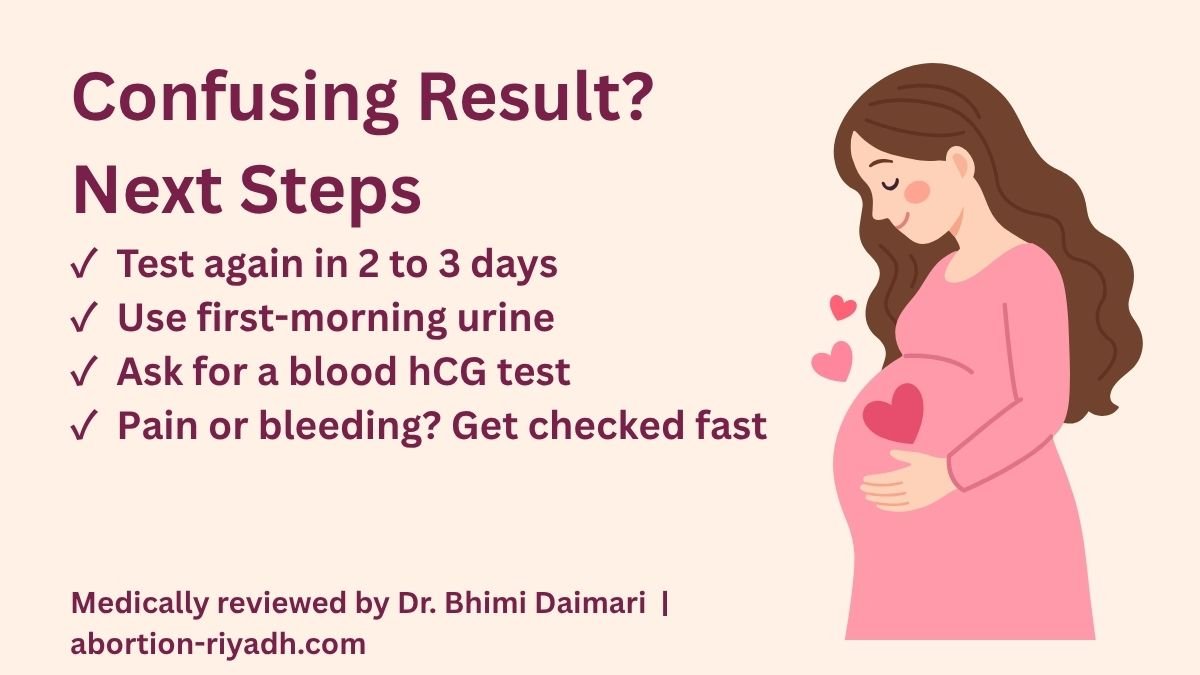
1. Repeat the test. Wait two or three days, use first morning urine and a new, in-date test. Set a timer and read the result only within the stated window. Our guide on how to use a pregnancy test kit lists the common mistakes.
2. Compare the lines. In a continuing early pregnancy, hCG rises quickly, so the test line normally gets darker over several days. A line that fades and then disappears suggests the level is falling.
3. Ask for a blood hCG test. A laboratory blood test measures the exact amount of hCG. One number tells a doctor little. Two tests taken about 48 hours apart show the direction: rising as expected, rising slowly, or falling. Typical ranges are in our guide to hCG levels by week.
4. Have an ultrasound when it is useful. A scan can confirm where the pregnancy is, but only once hCG is high enough, usually around five to six weeks after your last period. If hCG is positive and nothing is seen yet, doctors call this a pregnancy of unknown location and follow you with repeat tests until the answer is clear.
5. Tell the doctor your history. Mention any recent pregnancy, miscarriage, abortion or fertility treatment, your last period date and any medicines you take.
Until you have a clear answer, act as though you could be pregnant. Avoid alcohol and smoking, and check with a doctor or pharmacist before taking any medicine.
Get urgent care if you have a positive test, even a faint one, together with: severe pain low in your abdomen or on one side, pain at the tip of your shoulder, heavy vaginal bleeding, or dizziness or fainting. A pregnancy outside the uterus also gives a positive test and can be life-threatening. Go to an emergency department or call your local emergency number (997 in Saudi Arabia, 911 in the US).
A confusing test is stressful, whichever result you were hoping for. In most cases a repeat test and one or two blood tests give a clear answer within a week.
Frequently Asked Questions
How common is a false positive pregnancy test?
It is uncommon. Most home tests claim to be about 99% accurate when used from the day of a missed period and read as instructed. When a positive turns out not to be an ongoing pregnancy, the usual reason is a very early loss or a misread test, not a faulty kit.
Can a UTI cause a false positive pregnancy test?
A simple urinary tract infection does not produce hCG and should not turn a test positive. Urine with a lot of blood or protein in it can occasionally interfere with a test strip. If you have urinary symptoms and a positive test, see a doctor about both.
Can birth control pills or antibiotics affect a pregnancy test?
No. Birth control pills, most antibiotics, painkillers and alcohol do not change the result of a home pregnancy test. The main medicines that do are fertility injections that contain hCG.
Can two positive pregnancy tests both be wrong?
It is very unlikely if both showed a coloured line within the reading time. Two positives mean hCG was present on both occasions. A doctor can confirm with a blood test and, a little later, an ultrasound scan.
Why did I get a positive test and then start my period?
The likeliest explanation is a chemical pregnancy, where an embryo implanted long enough to make hCG and then stopped developing. The bleeding may be on time or a few days late and slightly heavier than usual. It is common and does not usually affect future pregnancies.
Can a pregnancy test be positive if you are not pregnant and never were?
Rarely, yes. Possible reasons include an evaporation line read as positive, a recent hCG injection, a small amount of hCG made by the pituitary gland around menopause, and some uncommon tumours. A persistent positive without a pregnancy always needs a medical check.
How long after a miscarriage will a pregnancy test stay positive?
hCG falls gradually and can keep a test positive for a few weeks. The time varies with how far along the pregnancy was. If a test is still positive beyond the time your doctor advised, or the line is getting darker, arrange a review.
Is a digital pregnancy test more accurate than a line test?
Both types detect hCG in the same way. A digital test removes the need to interpret lines, so it avoids evaporation-line confusion. Some digital tests need slightly more hCG to show a positive, so they may turn positive a little later.
Can drinking too much water cause a negative pregnancy test?
Yes, in very early pregnancy. Large amounts of fluid dilute your urine and can push a low hCG level below what the test can detect. Use the first urine of the morning when you test early.
Should I see a doctor after a positive home test?
Yes. A doctor can confirm the pregnancy, estimate how far along you are and talk through your options and next steps. Go sooner if you have pain, bleeding or a past ectopic pregnancy.
Related guides
- Positive vs negative pregnancy test results
- Faint line on a pregnancy test
- Chemical pregnancy: signs and causes
- hCG levels by week
- Cryptic pregnancy: when tests stay negative
- Signs of a miscarriage
- First 72 hours of pregnancy symptoms
Sources
- Mayo Clinic – Home pregnancy tests: Can you trust the results?
- NHS – Doing a pregnancy test
- MedlinePlus – Pregnancy test
- MedlinePlus – HCG blood test – quantitative
- Cleveland Clinic – Human Chorionic Gonadotropin (hCG)
- ACOG – Early Pregnancy Loss
This page is general health information and does not replace advice from your own doctor. In an emergency, call your local emergency number (997 in Saudi Arabia, 911 in the US).