
Medically reviewed by Dr. Bhimi Daimari, MBBS, MS (Obstetrics and Gynaecology) · Review date: 14 November 2026
Stories of people who did not know they were pregnant until late in pregnancy, or even until labour, sound impossible. They are real, though uncommon, and there are medical reasons behind them. This guide explains how a pregnancy can go unrecognised, the signs that get missed, and which online claims are not true.
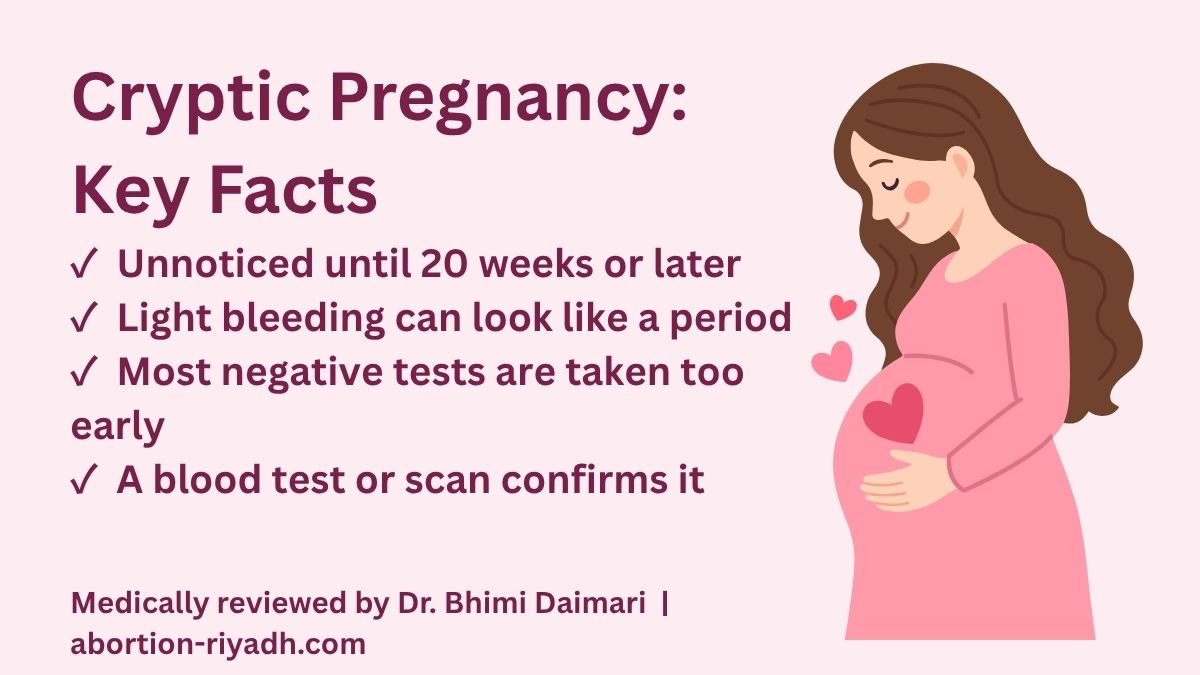
Quick answer: A cryptic pregnancy is one that the pregnant person does not recognise until 20 weeks or later, sometimes not until labour. Symptoms are mild, absent or blamed on something else, and bleeding may be mistaken for periods. It is still a normal-length pregnancy that a blood test and an ultrasound scan can detect. It does not last for years.
What is a cryptic pregnancy?
A cryptic pregnancy is a pregnancy that the pregnant person does not know about until it is well advanced. Doctors usually use the term when a pregnancy is recognised at 20 weeks or later. In a small number of cases, it is discovered only when labour starts.
You may also see it called a stealth pregnancy, a hidden pregnancy or a denied pregnancy. Medical papers often use “denial of pregnancy”. That phrase can sound like blame, but it covers two different situations:
- Unrecognised pregnancy. There are few or no typical signs, or the signs have a believable other explanation. The person has no reason to suspect pregnancy.
- Psychological denial. The mind does not accept the pregnancy, often because of fear, stress, trauma or very difficult circumstances. This is not lying. The person truly is not aware.
Both are different from a concealed pregnancy, in which someone knows they are pregnant and hides it from others.
How common is cryptic pregnancy?
Exact figures are hard to find, because studies are few and mostly from Europe. The most quoted one, a one-year study of births in Berlin, estimated that about 1 in 475 pregnancies was not recognised until 20 weeks or later. About 1 in 2,500 was not recognised until labour.
Treat these as approximate. Rates probably differ between countries and depend on access to health care, contraception use and how each study defined the term. What the figures do show is that cryptic pregnancy is uncommon but not vanishingly rare.
Why a pregnancy test can be negative
In many cryptic pregnancies, no test was taken because nobody thought of pregnancy. When a test was taken and came back negative, the usual reasons are ordinary ones.
- Wrong timing. A test done too soon after sex, before hCG has built up, will be negative. If that one result is trusted and never repeated, a pregnancy can be missed. This is more likely with irregular cycles, when you cannot tell that a period is late.
- Diluted urine. Testing after drinking a lot of fluid lowers the concentration of hCG. Early on, that can be enough to give a negative.
- Test errors. An expired kit, too little urine or reading the result at the wrong time all reduce accuracy. See how to use a pregnancy test kit.
- The hook effect. Some urine tests can read falsely negative when hCG is extremely high, or when broken-down forms of hCG dominate later in pregnancy. This is rare. A laboratory can get round it by diluting the sample.
There is no good evidence that a pregnancy in the second or third trimester produces “too little hCG” for a laboratory blood test to find. Typical values are in our guide to hCG levels by week, and our page on positive vs negative pregnancy test results explains how to read a home test.
Why bleeding can be mistaken for periods
You do not have true periods while pregnant. A period is the shedding of the uterine lining when no pregnancy has occurred. Bleeding during pregnancy is fairly common, though, and it can look convincing.
- Light spotting around implantation can arrive close to the date a period was due.
- Some people have episodes of light bleeding in the first months, from the cervix or from the edge of the placenta.
- Bleeding after sex is more likely because the cervix has a richer blood supply in pregnancy.
- Hormonal contraception can cause irregular bleeding, so unexpected spotting does not seem unusual.
If your periods have always been light, widely spaced or unpredictable, a few episodes of spotting can pass for normal. Our guide on how much bleeding is normal in early pregnancy describes the difference.
Who is more likely to have a cryptic pregnancy?
It can happen to anyone who is able to conceive, including people who have been pregnant before. It is more likely when a missed period would not stand out, or when pregnancy seems impossible.
- Polycystic ovary syndrome (PCOS) or irregular cycles. Going months without a period is already familiar.
- Recent birth or breastfeeding. Ovulation can return before the first period, so you can conceive without having had a period at all.
- Contraception users. No method is perfect. People who use birth control pills, an implant, an injection or an intrauterine device may not think of pregnancy, and some methods stop or disturb periods anyway.
- Perimenopause. Skipped periods, tiredness and weight change are expected, yet ovulation still happens from time to time.
- Athletes and people with low body fat. Hard training can stop periods, and strong abdominal muscles can hide a bump for longer.
- People told they are unlikely to conceive, or who believe they are infertile.
- People with a higher body weight, in whom changes in body shape may be less visible.
- Young people, and anyone under severe stress or in an unsafe situation, where psychological denial is more likely.
Cryptic pregnancy symptoms and hidden pregnancy signs
The symptoms are the same as in any pregnancy. They are milder, or they get explained away. The table shows the common ones.
| Sign | What it is often blamed on |
|---|---|
| Missed, lighter or irregular bleeding | PCOS, stress, contraception, perimenopause, breastfeeding |
| Nausea or food aversions | A stomach bug, reflux, anxiety |
| Tiredness | Work, poor sleep, low iron |
| Sore or fuller breasts | Premenstrual changes, weight gain |
| Weight gain or a firmer abdomen | Diet, bloating, constipation |
| Fluttering or rolling feelings in the abdomen | Gas, digestion, muscle twitches |
| Passing urine often, heartburn, backache | A bladder infection, diet, posture |
| Swollen feet, a stuffy nose, darker skin patches | Heat, allergies, sun exposure |
Body shape plays a part too. A uterus that tilts backwards, a baby lying towards the back or a placenta on the front wall can all make a bump smaller and movements softer. Our page on when you start showing in pregnancy explains why bump size varies so much.
If several of these signs appear together and you have had sex in the past year, take a pregnancy test, even if you use contraception or think pregnancy is unlikely.
Risks of a pregnancy without prenatal care
Many cryptic pregnancies end with a healthy parent and baby. The concern is what gets missed along the way.
- No screening. High blood pressure, pre-eclampsia, gestational diabetes, anaemia and infections are usually found at routine antenatal visits.
- No early supplements or advice. Folic acid in the first weeks lowers the chance of certain birth defects.
- Continued exposures. Alcohol, smoking and some medicines can affect a developing baby.
- No scans. Twins, a low-lying placenta, growth problems or a breech position may not be known before labour.
- Higher rates of preterm birth and low birth weight, as reported in studies of unrecognised pregnancy.
- Unplanned birth outside a hospital, without trained help.
- Emotional shock. Finding out late leaves little time to prepare, and extra support after the birth is often needed.
If you discover a pregnancy late, do not let guilt delay care. You could not act on what you did not know. Start antenatal care straight away, and tell the team about any medicines, alcohol or illnesses during the past months so they can check what matters.
Cryptic pregnancy myths on TikTok and social media
Online communities sometimes describe a very different kind of “cryptic pregnancy”. These claims do not match what is known about pregnancy.
Myth: a cryptic pregnancy can last two, three or more years. Human pregnancy lasts about 40 weeks from the last period. It does not pause or slow down for months.
Myth: the baby can hide from every ultrasound. After the first weeks, a pregnancy in the uterus is plainly visible on a scan. A tilted uterus or scar tissue does not conceal a growing baby.
Myth: blood and urine tests stay negative for the whole pregnancy. A single urine test can be wrong. A properly performed blood hCG test combined with a scan is not.
Myth: regular monthly periods continue as normal. Some bleeding can happen, but true cyclical periods do not.
If you feel sure you are pregnant but repeated blood tests and scans are negative, your symptoms are still real and deserve an explanation. Bloating, fibroids, ovarian cysts, thyroid problems, hormonal changes and false pregnancy (pseudocyesis) can all produce pregnancy-like symptoms. A doctor can look for the cause without judgement.
When to see a doctor
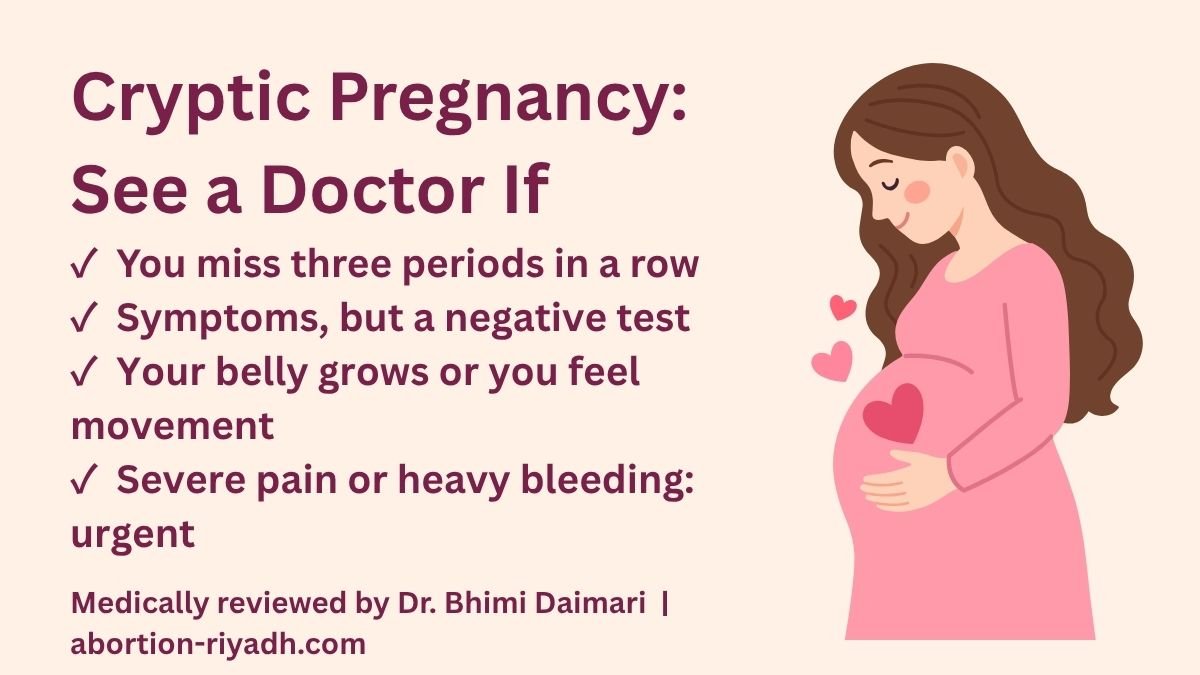
Book an appointment if:
- You have missed three periods in a row, or your cycle has changed without explanation.
- You have pregnancy symptoms and a negative home test.
- Your abdomen is growing or you feel movement inside it.
- You have just had a positive test and do not know how far along you are.
Tell the doctor plainly that pregnancy is possible. A blood hCG test and an ultrasound scan are quick, and they settle the question.
Go to an emergency department or call your local emergency number (997 in Saudi Arabia, 911 in the US) if you might be pregnant and have: severe abdominal pain, heavy vaginal bleeding, a gush of fluid from the vagina, strong regular tightenings or an urge to push, a severe headache with vision changes, sudden swelling of the face or hands, a seizure, or fainting.
Frequently Asked Questions
Can you be pregnant for months and not know?
Yes, it happens, although it is uncommon. It is more likely if your periods are irregular, your symptoms are mild, or you believe you cannot get pregnant. Most people in this situation find out in the second half of pregnancy.
Can you still have a period during a cryptic pregnancy?
You cannot have a true period while pregnant, because periods happen only when no pregnancy is present. Some people do have spotting or light bleeding at intervals during pregnancy, which can look like a light period. Any bleeding in a known pregnancy should be checked by a doctor.
How long can a cryptic pregnancy last?
It lasts as long as any other pregnancy, around 40 weeks from the last period. What differs is when it is discovered, not how long it continues. Claims of pregnancies lasting one or several years are not medically possible.
Can a blood test miss a cryptic pregnancy?
A laboratory blood hCG test is very reliable from around the time of a missed period onwards. A negative blood test together with a normal ultrasound scan means you are not pregnant. If symptoms continue, your doctor should look for another cause.
Can an ultrasound miss a pregnancy?
In the first five weeks a pregnancy may be too small to see. After that, a scan by a trained operator shows a pregnancy in the uterus, and later in pregnancy it cannot be hidden by the position of the uterus or by scar tissue. A scan aimed only at another organ could overlook it, so say that pregnancy is possible.
Do you gain weight or get a bump with a cryptic pregnancy?
Most people gain some weight and their abdomen grows, but the change can be small or carried in a way that is less obvious. It is often put down to diet, bloating or stress. People with a higher body weight or strong abdominal muscles may show very little.
Can you feel the baby move in a cryptic pregnancy?
The baby moves as in any pregnancy, but the movements may be mistaken for gas or digestion. A placenta attached to the front wall of the uterus can cushion them further. Rhythmic or rolling movements low in the abdomen are a reason to take a test.
Is cryptic pregnancy the same as a false pregnancy?
No, they are opposites. In a cryptic pregnancy there is a real pregnancy that has not been noticed. In a false pregnancy, also called pseudocyesis, a person has symptoms and a strong belief that they are pregnant, but tests and scans show no pregnancy.
What should I do if I think I have a hidden pregnancy?
Take a home urine test using first morning urine. If it is negative and you still have symptoms, ask a doctor for a blood hCG test and an ultrasound scan. These two tests together will give you a definite answer.
Related guides
- False positive pregnancy test
- Positive vs negative pregnancy test results
- When do you start showing in pregnancy?
- Implantation bleeding and when to test
- Pregnancy nose: why your nose changes
- Pelvic pain during pregnancy
- hCG levels by week
Sources
- Cleveland Clinic – Cryptic Pregnancy
- Wessel J, Buscher U. Denial of pregnancy: population based study. BMJ. 2002;324:458
- NHS – Signs and symptoms of pregnancy
- Mayo Clinic – Home pregnancy tests: Can you trust the results?
- MedlinePlus – Pregnancy test
- WHO – Recommendations on antenatal care for a positive pregnancy experience
This page is general health information and does not replace advice from your own doctor. In an emergency, call your local emergency number (997 in Saudi Arabia, 911 in the US).