

Bleeding in early pregnancy is frightening and many women hear the words (inevitable abortion) for the first time in an emergency room. This guide explains in simple words what the term means what symptoms to watch for how doctors confirm it what treatment involves and how it differs from threatened, incomplete and missed abortion.
Emergency in Saudi Arabia: If you are pregnant and have heavy bleeding (soaking a pad within an hour), severe tummy pain, shoulder pain, fever, or you feel faint, call 997 or go to the nearest emergency department now. For non-urgent advice, call the MOH helpline on 937.
What is inevitable abortion?
Inevitable abortion is a medical term for a miscarriage that has already started and cannot be stopped. “Abortion” here does not mean a planned termination. In medical language, “spontaneous abortion” simply means a pregnancy that ends on its own before 20 weeks.
A miscarriage is called inevitable when:
- there is vaginal bleeding, often with cramping, and
- the cervix (the neck of the womb) has opened, but
- the pregnancy tissue has not yet come out.

Once the cervix opens, the pregnancy cannot continue. Doctors now often call it “inevitable pregnancy loss” or “inevitable miscarriage”, according to the medical review Early Pregnancy Loss (Spontaneous Abortion) on NCBI StatPearls.
Symptoms of inevitable abortion
Common signs include:
- Vaginal bleeding, often heavier than a period, sometimes with clots
- Cramping or pain in the lower tummy or lower back, which may come in waves
- Fluid leaking from the vagina (the waters breaking, in a later pregnancy)
- Pregnancy symptoms fading, such as less nausea or breast tenderness
The NHS guide to miscarriage symptoms lists the same signs. It also describes tissue that may look like pink, grey or white lumps.
Only a doctor can tell whether the cervix is open, so any bleeding in pregnancy needs a medical check. Do not try to judge it at home.
What causes inevitable abortion?
Most early miscarriages are not caused by anything the woman did. Common causes include:
- Chromosome problems in the baby. This is the most common cause in the first trimester, and it happens by chance.
- Problems with the womb or cervix, such as fibroids or a weak cervix
- Uncontrolled health conditions, such as diabetes or thyroid disease
- Infections
- Older age of the mother (over 35)
Normal exercise, work, sex and travel do not cause miscarriage.
How do doctors confirm inevitable abortion?
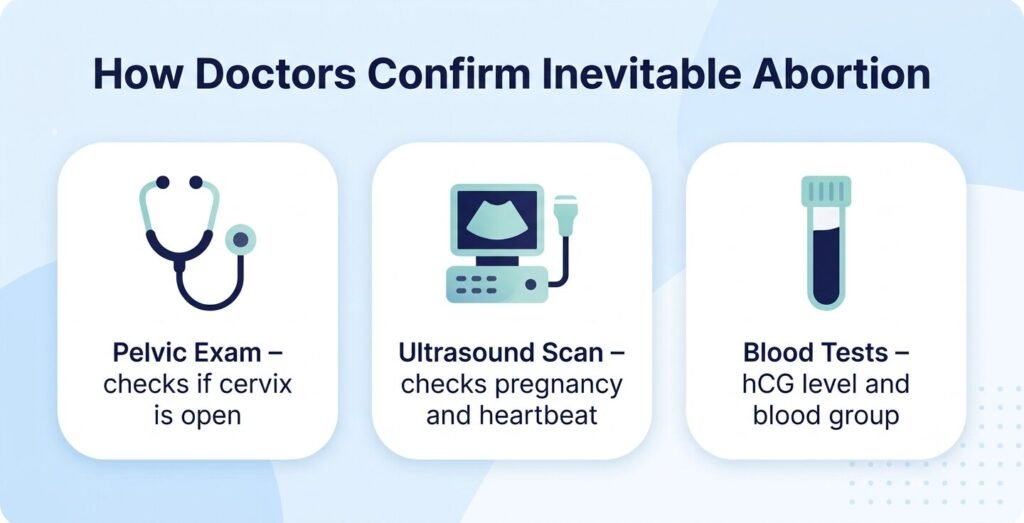
A doctor usually does:
- A pelvic (internal) examination to check whether the cervix is open
- An ultrasound scan to look at the pregnancy, the baby’s heartbeat and any tissue still in the womb
- Blood tests, such as hCG levels, blood count and blood group. If you are Rh-negative, you may need an anti-D injection.
On ultrasound, an inevitable abortion often shows an open cervix. The pregnancy may be low in the womb or partly passing.
Inevitable vs threatened vs incomplete vs missed abortion
Doctors use different names depending on the cervix and whether tissue has passed:
| Type | Bleeding / pain | Cervix | Tissue passed? | Can the pregnancy continue? |
|---|---|---|---|---|
| Threatened abortion | Yes, usually light | Closed | No | Yes, often |
| Inevitable abortion | Yes, often heavy with cramps | Open | No (not yet) | No |
| Incomplete abortion | Yes, heavy | Open | Some | No |
| Complete abortion | Bleeding settles | Closes again | All | No |
| Missed abortion | Often none | Closed | No | No (baby has stopped growing) |
Read more in our guides on incomplete abortion and miscarriage, or see all types of abortion explained with a chart.
How is inevitable abortion treated?
Treatment depends on how many weeks pregnant you are, how heavy the bleeding is, and your general health. According to the StatPearls review of early pregnancy loss, there are three main options:
Video: Dr. Randy Morris, M.D., explains the three ways a miscarriage can be managed – waiting, medicine, or a minor procedure.
1. Waiting (expectant management)
The body passes the pregnancy naturally. This is suitable when bleeding is not dangerous and there is no infection. Many women complete the miscarriage within a few weeks.
2. Medicine (medical management)
A doctor may prescribe medicine to help the womb empty faster. This must be prescribed and supervised by a licensed doctor. Never take abortion or miscarriage pills without a doctor’s prescription.
3. A minor procedure (surgical management)
The womb is gently emptied with suction (vacuum aspiration, or D&C). This is needed urgently if there is heavy bleeding, infection, or low blood pressure. Some women also choose it.
After treatment, your doctor may advise:
- a follow-up scan or pregnancy test to make sure the womb is empty (see cleaning the uterus after abortion)
- an anti-D injection if you are Rh-negative
- rest, pain relief, and watching for warning signs
Warning signs after an inevitable abortion
Go to the emergency department or call 997 if you have:
- bleeding that soaks more than 2 pads an hour for 2 hours
- fever or chills
- bad-smelling vaginal discharge
- severe pain that does not improve
- dizziness or fainting
Recovery and the next pregnancy
- Bleeding usually settles within 1–2 weeks.
- Your period usually returns in 4–6 weeks.
- Most women go on to have a healthy pregnancy later. Ask your doctor when it is safe to try again (see pregnancy after abortion).
- Sadness, guilt or anxiety are normal. Support helps. Read our guide on emotional health after abortion.
Frequently Asked Questions
What is the definition of inevitable abortion?
Inevitable abortion is a miscarriage that cannot be stopped. There is bleeding and cramping, and the cervix has opened, but the pregnancy tissue has not passed yet.
What is the difference between threatened and inevitable abortion?
In a threatened abortion the cervix is closed and the pregnancy can often continue. In an inevitable abortion the cervix is open, so the pregnancy cannot continue. The medical review Threatened Miscarriage (StatPearls) defines threatened miscarriage by a closed cervix with a viable pregnancy.
How to treat an inevitable abortion?
A doctor may advise waiting for the miscarriage to finish naturally, prescribe medicine to help the womb empty, or do a minor suction procedure. Heavy bleeding or infection needs urgent hospital treatment. Never take medicine without a doctor’s prescription.
What is the difference between inevitable and missed abortion?
An inevitable abortion has bleeding, cramps and an open cervix. A missed abortion usually has no symptoms: the baby has stopped growing, but the cervix stays closed and the tissue stays in the womb. It is usually found on a routine scan.
What are the three types of abortions?
Doctors often describe the main types of spontaneous abortion (miscarriage) as threatened, inevitable and incomplete. Complete and missed abortion are also used. Separately, induced abortion means a pregnancy ended on purpose, by medicine or by a procedure.
What is a silent miscarriage?
A silent miscarriage is another name for a missed miscarriage. The pregnancy has stopped developing, but there is no bleeding or pain, so the woman may not know until an ultrasound shows it. Learn more in our miscarriage guide.
References
- Early Pregnancy Loss (Spontaneous Abortion), StatPearls, NCBI Bookshelf
- Threatened Miscarriage, StatPearls (PubMed)
- Miscarriage symptoms, NHS
Medically reviewed by Dr. Bhimi Daimari, MS (Obstetrics & Gynaecology)
MS Obstetrics & Gynaecology · Reg. No. 23218, Assam Council of Medical Registration · Last reviewed: 30 October 2026
About the medical reviewer
Dr. Bhimi Daimari, MS (Obstetrics & Gynaecology)
Dr. Bhimi Daimari is a gynaecologist with an MS in Obstetrics and Gynaecology from Fakhruddin Ali Ahmed Medical College, Barpeta (Srimanta Sankaradeva University of Health Sciences). She is registered with the Assam Council of Medical Registration (Reg. No. 23218). She reviews all medical content on Abortion Riyadh for accuracy and safety.
Email: daimaribhimi@gmail.com
Disclaimer: This article is for education only and is not a substitute for medical advice. If you are pregnant and bleeding, see a licensed doctor at an authorized facility in Saudi Arabia, or call 997 in an emergency.