
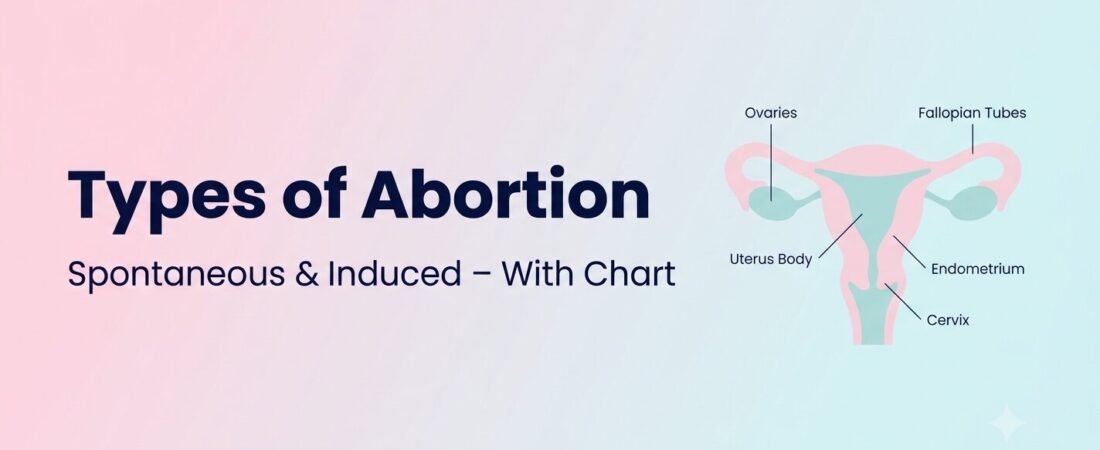
Key takeaways
- In medicine, “abortion” means any pregnancy that ends before 20 weeks. This includes miscarriage.
- There are two main groups: spontaneous abortion (miscarriage, which happens on its own) and induced abortion (ended with medicine or a procedure).
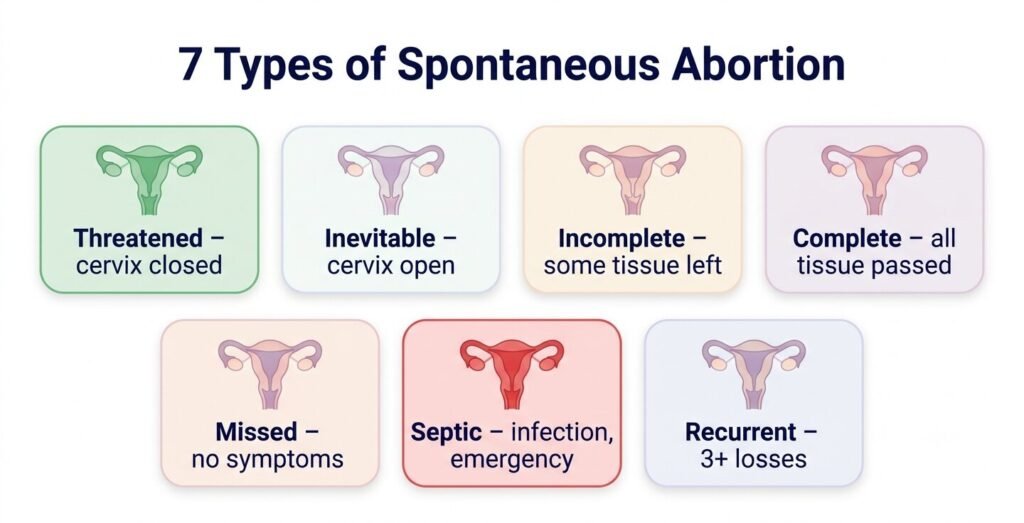
- Doctors describe 7 types of spontaneous abortion: threatened, inevitable, incomplete, complete, missed, septic and recurrent.
- Induced abortion has 2 methods: medical (pills) and surgical (a procedure).
- Bleeding in pregnancy always needs a doctor’s check. Emergency in Saudi Arabia: call 997.
How many types of abortion are there?
Doctors divide abortion into two main groups:
- Spontaneous abortion (miscarriage) The pregnancy ends on its own, without any medicine or procedure. It is common: about 10–20% of known pregnancies end this way, mostly in the first 12 weeks.
- Induced abortion The pregnancy is ended on purpose, with medicines or a procedure by a doctor.
According to the WHO fact sheet on abortion, induced abortion is safe when done with a recommended method by a trained provider, and unsafe abortion remains a leading, preventable cause of harm to women.
Types of spontaneous abortion (miscarriage)
1. Threatened abortion
Light bleeding with a closed cervix. The pregnancy is still alive and often continues. Read our full guide on threatened abortion.
2. Inevitable abortion
Bleeding and cramps with an open cervix. The miscarriage has started and cannot be stopped. See inevitable abortion.
3. Incomplete abortion
Some pregnancy tissue has passed, but part of it is still inside the womb. Bleeding is often heavy, and it usually needs treatment. See incomplete abortion.
4. Complete abortion
All the pregnancy tissue has passed. Bleeding and pain settle, and the cervix closes again. A follow-up scan or test confirms the womb is empty.
5. Missed abortion (silent miscarriage)
The pregnancy has stopped growing, but there is no bleeding or pain and the cervix stays closed. It is usually found on a routine ultrasound.
6. Septic abortion
A miscarriage or abortion complicated by infection of the womb. Signs include fever, chills, bad-smelling discharge and severe pain. This is an emergency, so call 997.
7. Recurrent miscarriage
Guidelines define it differently. For many years it meant three or more losses in a row. Newer ASRM guidance (2026) uses two or more pregnancy losses, which do not need to be in a row. It needs tests to look for a cause, such as hormone, blood-clotting, womb-shape or chromosome problems.
The medical review Early Pregnancy Loss (StatPearls) explains how doctors use bleeding, the cervix and ultrasound to tell these types apart.
Types of abortion table (chart)
| Type | Bleeding / pain | Cervix | Tissue passed? | Pregnancy continues? |
|---|---|---|---|---|
| Threatened | Light, mild cramps | Closed | No | Often yes |
| Inevitable | Heavy, strong cramps | Open | Not yet | No |
| Incomplete | Heavy | Open | Some | No |
| Complete | Settling | Closed | All | No |
| Missed | Usually none | Closed | No | No |
| Septic | Bleeding + fever | Varies | Varies | No (emergency) |
| Recurrent | Varies | Varies | Varies | Depends on cause |
Types of induced abortion (procedures)
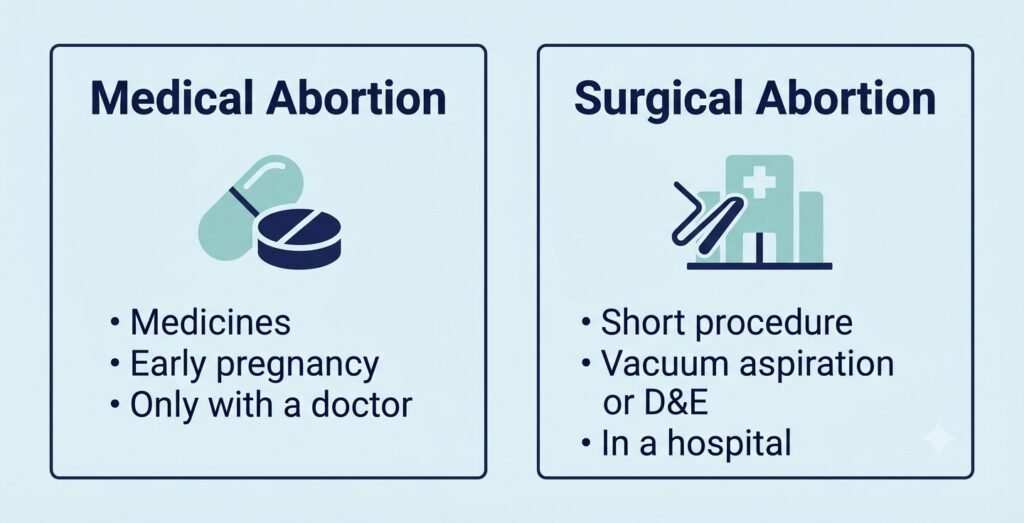
Medical abortion (abortion pills)
A medical abortion uses medicines to end an early pregnancy. The two medicines used worldwide are mifepristone and misoprostol (see abortion pill names and how the abortion pill works). These medicines must only be used under the care of a licensed doctor, who checks how far along the pregnancy is and rules out an ectopic pregnancy first.
Surgical abortion
A short procedure that removes the pregnancy from the womb:
- Vacuum (suction) aspiration: usually used in early pregnancy.
- Dilation and evacuation (D&E): used later in pregnancy.
The NHS guide to abortion explains both methods. Read our comparison of medical vs surgical abortion.
Medical abortion vs surgical abortion: comparison
| Medical abortion | Surgical abortion | |
|---|---|---|
| What it involves | Medicines make the womb empty itself, like a heavy, crampy period | A short procedure: vacuum aspiration, or D&E later in pregnancy |
| Where it is done | Started in a clinic; part may happen at home if the doctor advises | In a clinic or hospital |
| Medical supervision | Doctor confirms weeks of pregnancy and rules out ectopic pregnancy first | Done by a trained doctor, with local anaesthetic or sedation |
| Possible risks | Heavy bleeding, incomplete abortion, infection (uncommon) | Bleeding, infection, rarely injury to the cervix or womb |
| Follow-up care | A test or scan to confirm it is complete | A check if symptoms continue |
Both methods are also used to finish an incomplete or missed miscarriage. Sources: ACOG – Induced Abortion and the WHO Abortion Care Guideline. Learn more about how safe the abortion pill is and what to expect after.
Is abortion legal in Saudi Arabia?
Saudi law allows abortion only in limited medical situations, approved by doctors in a licensed hospital. Read our guide on the abortion law in Saudi Arabia. Never buy pills online: they are often fake and can be dangerous.
Warning signs: when to go to the hospital
Call 997 or go to the emergency department if you have:
- bleeding that soaks 2 pads an hour for 2 hours
- fever, chills or bad-smelling discharge
- severe pain, especially on one side
- dizziness, fainting or shoulder-tip pain
- pregnancy symptoms that do not go away after 1–2 weeks
Some bleeding and cramps are normal after a miscarriage or abortion. The signs above are not. Sources: NHS – Abortion risks and ACOG – Early Pregnancy Loss. See also bleeding after Cytotec.
When should you see a doctor?
See a doctor as soon as you know you are pregnant and have any bleeding or pain. A doctor can:
- confirm the pregnancy and how many weeks it is
- do an ultrasound, when needed, to check the pregnancy is in the womb and growing
- tell which type of miscarriage it is, if any, and explain the options
- check afterwards that the womb is empty and there is no infection
- support your feelings, see emotional health after abortion
In Saudi Arabia: call the Ministry of Health line 937 for medical advice, or 997 in an emergency.
Frequently Asked Questions
How many types of abortion are there?
There are two main groups: spontaneous (miscarriage) and induced. Doctors describe 7 types of spontaneous abortion: threatened, inevitable, incomplete, complete, missed, septic and recurrent.
What are the 5 types of abortion?
In many textbooks, the 5 main types of spontaneous abortion are threatened, inevitable, incomplete, complete and missed. Septic and recurrent miscarriage are often added to make 7.
What are the three types of abortions?
The three most commonly taught types are threatened, inevitable and incomplete abortion, the stages a miscarriage can move through.
What is the difference between spontaneous and induced abortion?
A spontaneous abortion (miscarriage) happens on its own. An induced abortion is ended on purpose, with medicine or a procedure by a doctor.
What are the types of abortion procedures?
There are two: medical abortion (pills, used in early pregnancy) and surgical abortion (vacuum aspiration or D&E). Both must be done by licensed doctors.
Which type of abortion is dangerous?
Septic abortion and any unsafe abortion done without a trained doctor are the most dangerous. Heavy bleeding or fever after any pregnancy loss needs emergency care.
What is the difference between medical and surgical abortion?
Medical abortion uses medicines that make the womb empty itself. Surgical abortion is a short procedure, usually vacuum aspiration, done by a doctor in a clinic or hospital.
What is a missed miscarriage?
The pregnancy has stopped growing, but there is no bleeding or pain. It is usually found on a routine ultrasound scan.
What is an incomplete miscarriage?
Some pregnancy tissue stays in the womb. It can cause ongoing bleeding and pain and may need medicine or a small procedure. See incomplete abortion.
When should someone seek emergency medical attention?
For very heavy bleeding, severe belly pain, fever, bad-smelling discharge, or feeling faint. In Saudi Arabia, call 997.
Can someone become pregnant after a miscarriage?
Yes. Most women have a healthy pregnancy after a miscarriage, and ovulation can return within a few weeks. See pregnancy after abortion.
Does every miscarriage require medical treatment?
No. Many early miscarriages complete on their own. A doctor should still check that it is complete and there is no infection.
References
- Abortion – WHO Fact Sheet
- Early Pregnancy Loss (Spontaneous Abortion), StatPearls, NCBI Bookshelf
- Abortion, NHS
- Early Pregnancy Loss, ACOG
- Induced Abortion, ACOG
- Abortion Care Guideline, WHO
- Updated guidance on recurrent pregnancy loss, ASRM (2026)
About the medical reviewer
Medically reviewed by Dr. Bhimi Daimari, MS (Obstetrics & Gynaecology)
MS Obstetrics & Gynaecology · Reg. No. 23218, Assam Council of Medical Registration · Published: 31 October 2026 · Last updated: 1 November 2026
Dr. Bhimi Daimari, MS (Obstetrics & Gynaecology)
Dr. Bhimi Daimari is a gynaecologist with an MS in Obstetrics and Gynaecology from Fakhruddin Ali Ahmed Medical College, Barpeta (SSUHS), registered with the Assam Council of Medical Registration (Reg. No. 23218). She reviews all medical content on Abortion Riyadh.
Email: daimaribhimi@gmail.com
Medical disclaimer: This article is for general education only and is not a substitute for advice, diagnosis or treatment from a qualified doctor. If you are pregnant and have bleeding, pain or fever, see a licensed doctor in Saudi Arabia, or call 997 in an emergency.