

MBBS, MS (Obstetrics and Gynaecology) · Assam Medical Council Reg. 23218
Last reviewed: 11 November 2026
Cytotec is one of the most searched medicine names in Saudi Arabia, and also one of the most misunderstood. It is sold as a stomach medicine, yet most people who look it up are asking about pregnancy. This guide explains what Cytotec is, what it is licensed for, how doctors use misoprostol in obstetrics, the rules that apply to Cytotec in Saudi Arabia, and why using it without a doctor is dangerous. This site is educational only and does not sell or supply any medicine.
Quick answer: Cytotec is the Pfizer brand name for misoprostol, a synthetic prostaglandin. Its licensed use is to lower the risk of stomach ulcers in people who take NSAID painkillers. Misoprostol also makes the uterus contract and softens the cervix, so obstetricians use it under supervision for induction of labour, bleeding after birth and miscarriage care. For the same reason it carries a strong pregnancy warning. In Saudi Arabia it is a prescription-only, tightly restricted medicine, and abortion is allowed only in limited medical circumstances approved by a medical committee. Taking Cytotec pills without a doctor can cause heavy bleeding, incomplete miscarriage, infection or a missed ectopic pregnancy.

What is Cytotec?
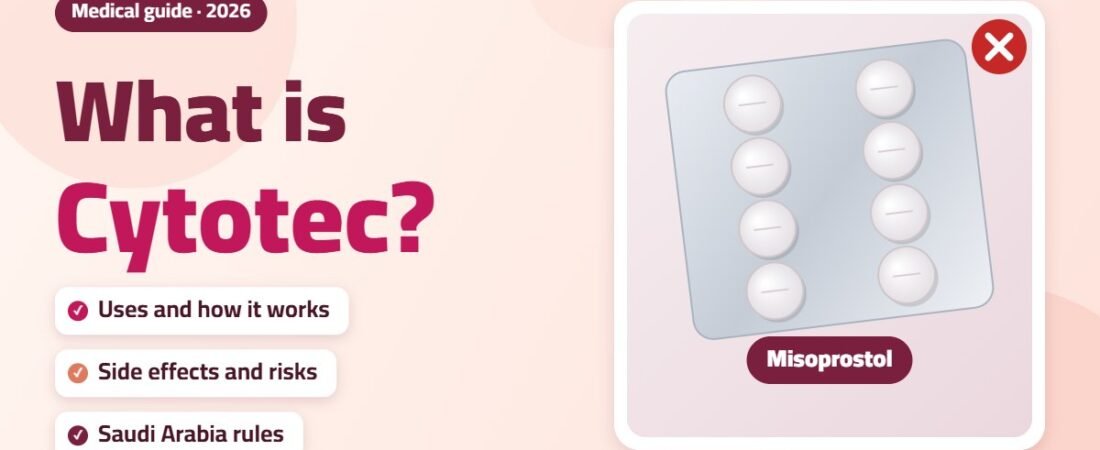
Cytotec is a brand of misoprostol tablets. It was developed by G.D. Searle in the 1980s and is now made by Pfizer. Misoprostol is a man-made copy of prostaglandin E1, a substance the body produces naturally in the stomach lining, the uterus and many other tissues.
The same active ingredient is sold under other brand names and as generics in different countries. The name on the box changes, but the medicine inside is the same. You can read about the ingredient itself in our guide to misoprostol in Saudi Arabia: uses, side effects and the law.
Arabic readers can go to our main Cytotec page: سايتوتك في السعودية (Arabic).
Can you tell a real Cytotec tablet by how it looks?
No. Counterfeit tablets are often made to look exactly like the genuine product, so a tablet that looks right is not proof that it is real or that it has been stored properly. Prescription medicines should only come from a licensed source on a doctor’s prescription. See how to spot fake abortion pills in Saudi Arabia.
Which medicine is used, how much, and how, is a decision for the prescribing doctor only.
Cytotec uses: what is it licensed for?
Cytotec is licensed for one thing: reducing the risk of stomach (gastric) ulcers caused by non-steroidal anti-inflammatory drugs (NSAIDs) such as aspirin, ibuprofen and diclofenac, in people at high risk of ulcer complications.
NSAIDs block the prostaglandins that protect the stomach lining. Misoprostol replaces that protection. It reduces acid and increases the mucus and bicarbonate that shield the stomach wall.
Every other use described on this page is “off-label” for the Cytotec brand. Off-label does not mean wrong. It means the manufacturer never applied for that use, and doctors rely on separate research to support it.
How Cytotec pills act on the uterus
Misoprostol makes the muscle of the uterus contract and makes the cervix softer and more open. Natural prostaglandins do the same at the start of labour.
This is why Cytotec carries a boxed pregnancy warning, the strongest type of warning on a medicine label. The manufacturer states that misoprostol given to pregnant women can cause birth defects, abortion (sometimes incomplete), premature birth or rupture of the uterus. A woman who is prescribed Cytotec for her stomach is expected to have a negative pregnancy test first and to use reliable contraception during treatment.
Two points in that warning are often missed:
- It does not always end a pregnancy. When it fails and the pregnancy continues, reports have linked first-trimester exposure to birth defects affecting the skull, the facial nerves and the limbs.
- The risk of uterine rupture rises with later pregnancy and with any scar on the uterus, including a previous caesarean section.
What is Cytotec used for in pregnancy and gynaecology?
Doctors use misoprostol in pregnancy care for induction of labour, bleeding after childbirth, miscarriage management and preparing the cervix before a procedure. The World Health Organization (WHO) keeps misoprostol on its Model List of Essential Medicines for these purposes, and the International Federation of Gynecology and Obstetrics (FIGO) publishes guidance for specialists.
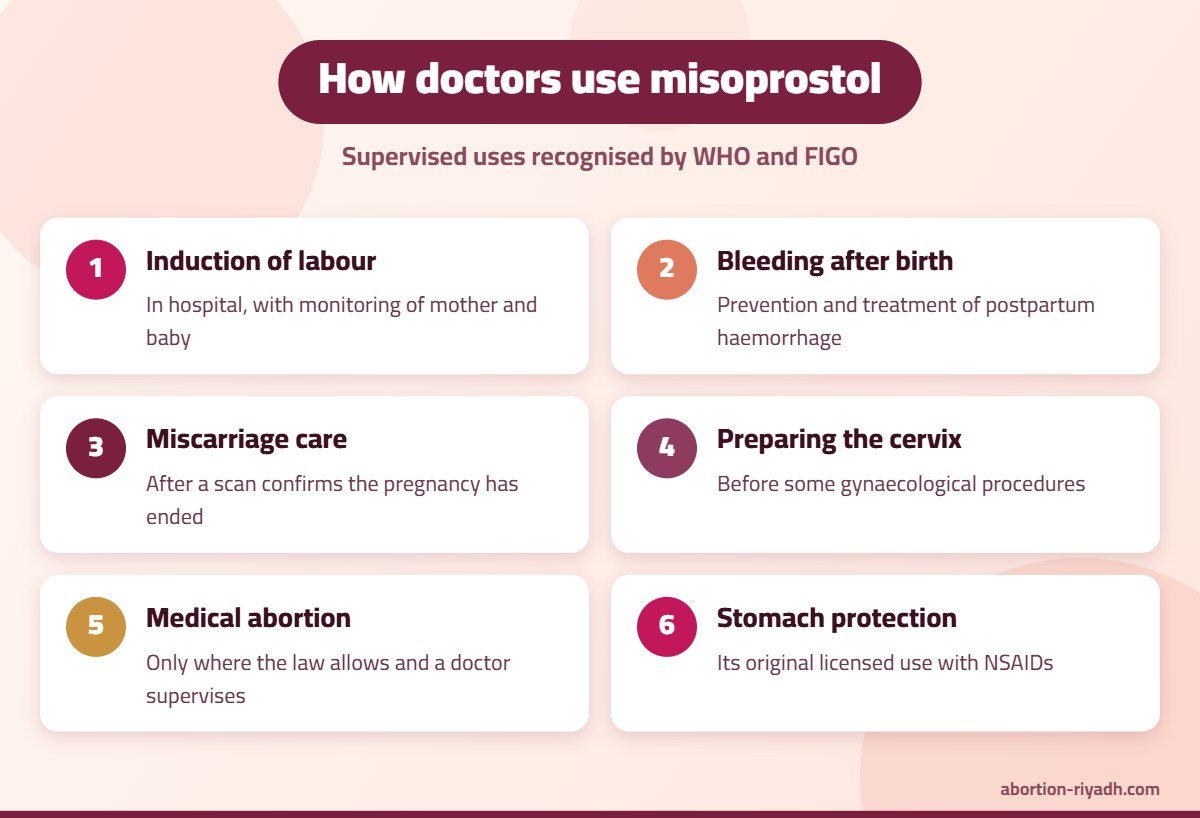
The recognised uses are:
- Induction of labour. To ripen the cervix and start contractions when it is safer for the baby to be born than to wait. This is done in hospital with monitoring of contractions and the baby’s heartbeat.
- Postpartum haemorrhage. To help the uterus contract after birth and reduce heavy bleeding, mainly where the first-choice injection (oxytocin) is not available or has not worked.
- Managing miscarriage. To help the uterus empty after a missed miscarriage or an incomplete abortion, as an alternative to a surgical procedure.
- Pregnancy loss later in pregnancy (fetal death in the womb), to bring on delivery.
- Cervical preparation. To soften the cervix before a procedure inside the uterus, such as surgical evacuation or hysteroscopy.
- Medical abortion, in countries and circumstances where it is legal, usually together with mifepristone.
In every one of these, the doctor first confirms where the pregnancy is and how far along it is, checks for reasons the medicine should not be used, and arranges follow-up.
Is Cytotec used for abortion?
Yes. Misoprostol is one of the two medicines used for medical abortion in countries where abortion is legal, and WHO includes it in its abortion care guideline. It is usually given after mifepristone, and can be used alone where mifepristone is not available, although the combination works better. We explain the science in how does the abortion pill work?
That medical fact does not change the legal position in the Kingdom. In Saudi Arabia, ending a pregnancy is permitted only in limited medical situations, mainly when continuing the pregnancy threatens the mother’s life or would seriously harm her health, and the decision has to be approved by a committee of specialist doctors in a licensed hospital. Our page on abortion law in Saudi Arabia sets out the rules in detail. For wider background, see our complete guide to abortion pills in Saudi Arabia.
Cytotec in Saudi Arabia: the rules in Riyadh, Jeddah and other cities
Cytotec in Saudi Arabia is a prescription-only medicine that is tightly restricted, and the rules are the same in Riyadh, Jeddah, Dammam and every other city. There is no region where it is treated as an over-the-counter product.
What this means in practice:
- A doctor decides, not the patient. Misoprostol for pregnancy-related reasons is used by obstetricians inside licensed hospitals and clinics, where the woman can be examined, scanned and monitored.
- The Saudi Food and Drug Authority (SFDA) controls it. The SFDA regulates which medicines may be imported, tracks packs through its electronic track-and-trace system and issues recalls. In 2023, for example, it recalled a batch of a misoprostol product at hospital level because the batch did not meet technical requirements.
- Buying it outside official channels breaks the regulations. Pills offered through social media, messaging apps or unknown websites are outside this system entirely. Nobody has checked what they contain.
- The pregnancy warning applies in full. A doctor will not prescribe it to a pregnant woman for stomach protection, and its use to end a pregnancy is bound by the law described above.
A note on accuracy: which misoprostol brands are registered in the Kingdom, and in which settings they may be dispensed, can change. We could not find a public SFDA document that lists the current status of the Cytotec brand itself. For the latest position, check the SFDA drug list or ask a licensed pharmacist or your doctor. Suspected fake or unsafe medicines can be reported to the SFDA on 19999.
It is restricted because of what it does to the uterus. A medicine that can end a pregnancy, cause birth defects when it fails and trigger dangerous bleeding needs a diagnosis before it and medical care after it.
Dangers of using Cytotec without a doctor
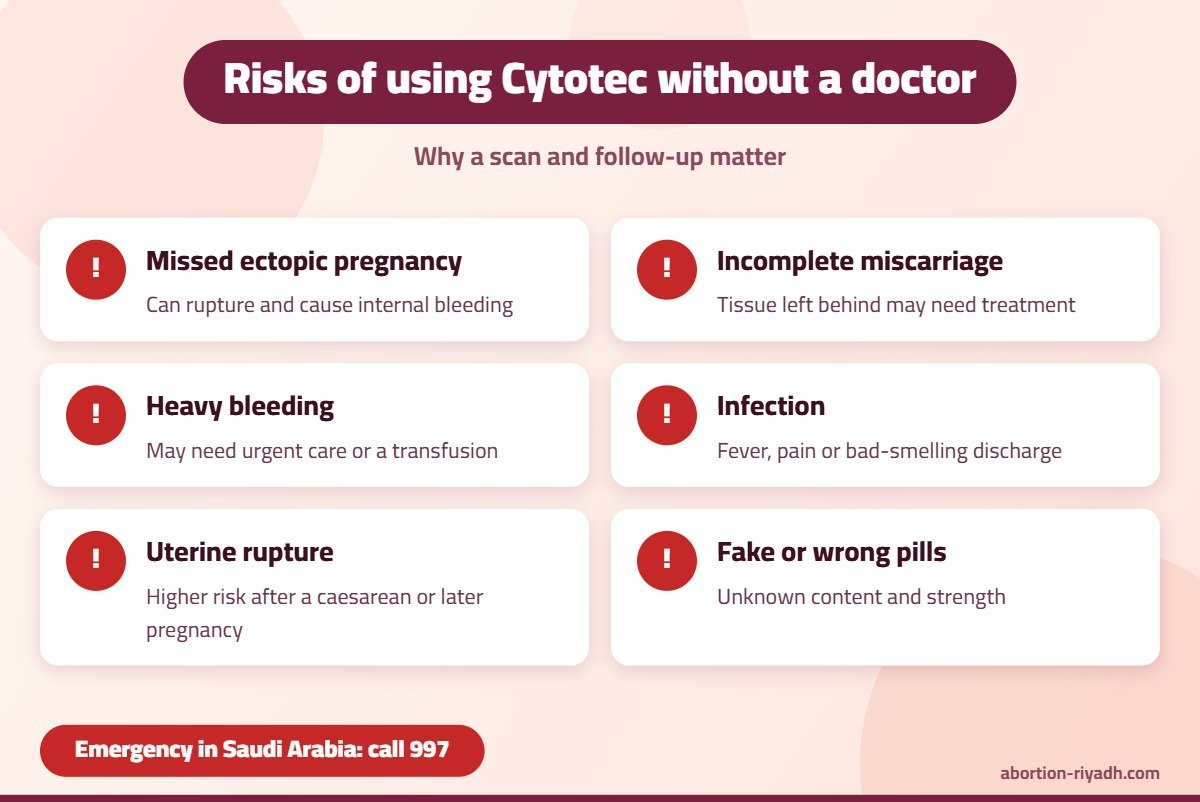
The main danger of taking Cytotec without a doctor is that nobody has confirmed the pregnancy is inside the uterus, how many weeks it is, or whether the medicine is safe for you.
- Missed ectopic pregnancy. Misoprostol does not treat a pregnancy growing in the tube. A woman may bleed, believe the pregnancy has ended and stay at home while the tube is close to rupturing.
- Incomplete miscarriage. Part of the pregnancy tissue can stay inside, causing bleeding that goes on for weeks, cramps and a risk of infection. See incomplete abortion.
- Heavy bleeding (haemorrhage). Some women bleed enough to need a blood transfusion or an emergency procedure.
- Infection. Retained tissue can become infected. Fever, pelvic pain and foul-smelling discharge are the warning signs, and untreated infection can spread to the blood.
- Rupture of the uterus. The risk is higher later in pregnancy and in women with a previous caesarean section or other surgery on the uterus. A rupture is life-threatening.
- A continuing pregnancy. If the medicine fails, the baby has been exposed to a drug linked to birth defects.
- Fake or damaged pills. Tablets sold illegally may contain little or no misoprostol, or a different drug. Misoprostol also breaks down when exposed to heat and humidity, so loose tablets or cut blister strips may no longer work.
For more on the risks, read abortion pill side effects and safety.
Cytotec side effects
The most common Cytotec side effects are diarrhoea and abdominal pain. In the manufacturer’s studies of people taking it for stomach protection, roughly one in ten had diarrhoea. It usually started early in treatment and settled within about a week.
Other side effects reported in more than 1 in 100 people:
- nausea and vomiting
- wind and indigestion
- headache
- constipation
When doctors use misoprostol for obstetric reasons, cramping and vaginal bleeding are expected, because they are how the medicine works. Shivering, chills and a short-lived rise in temperature are also common in the first hours. A fever that lasts into the next day, or starts a day or more later, is not a normal side effect and needs a check for infection.
Anyone who has had an allergic reaction to a prostaglandin should not take Cytotec.
Arabic readers who want to know what bleeding to expect can read أخذت سايتوتك ولم ينزل دم؟ (Arabic).
Red flags: when to get emergency help
Go to the nearest emergency department now if you have taken misoprostol, or think you may be miscarrying, and you have:
- bleeding that soaks two or more large pads an hour for two hours in a row, or large clots that keep coming
- severe abdominal pain that painkillers do not ease
- pain on one side of the lower abdomen with dizziness, or pain at the tip of the shoulder
- fainting, a racing heart or feeling very weak
- fever of 38°C or higher, chills or foul-smelling discharge
- sudden strong pain in a woman who has had a caesarean section
In Saudi Arabia call 997 for an ambulance, or 911 in regions covered by the unified emergency number. For medical advice by phone, the Ministry of Health line is 937. Tell the staff what you took and when.
Cytotec vs mifepristone
Cytotec and mifepristone are different medicines that do different jobs. Mifepristone blocks progesterone, the hormone that keeps a pregnancy attached and growing. Misoprostol, the drug in Cytotec, makes the uterus contract and the cervix open.
- Licensed purpose: mifepristone was developed for ending early pregnancy. Cytotec was developed for stomach ulcers.
- Used alone or together: where medical abortion is legal, WHO recommends the two together because the combination is more effective than misoprostol alone.
Neither is a medicine a woman can lawfully obtain for herself over the counter in Saudi Arabia. Read more in our guide to mifepristone: what it is, how it works and side effects.
When to see a doctor
See a gynaecologist before anything else if your period is late, a pregnancy test is positive, or you are bleeding in pregnancy. An ultrasound scan answers the questions that matter most: whether the pregnancy is in the uterus, how many weeks it is and whether it is developing normally.
Book an appointment within a day or two if you:
- have taken Cytotec and have had no bleeding, or still feel pregnant
- are still bleeding more than two weeks after a miscarriage or after taking misoprostol
- have a positive pregnancy test four weeks or more afterwards
- were prescribed Cytotec for your stomach and think you might be pregnant
- have a health reason that makes you worry about continuing a pregnancy. A doctor can tell you what the law allows in your situation.
Frequently Asked Questions
What is Cytotec used for in pregnancy?
In hospital practice, obstetricians use misoprostol to start labour, to control bleeding after delivery and to help the uterus empty after a miscarriage or a pregnancy loss. The decision depends on the scan, the number of weeks and the woman’s history, for example whether she has had a caesarean. Outside these supervised situations, Cytotec should not be taken in pregnancy at all.
Does Cytotec used for abortion always work?
No. Misoprostol on its own fails more often than the mifepristone and misoprostol combination, and the chance of failure rises as pregnancy advances. Counterfeit or heat-damaged tablets fail far more often. A failed attempt can leave a continuing pregnancy that has been exposed to the drug, or tissue left in the uterus, and both need medical care.
Is Cytotec the same as misoprostol?
Cytotec is a brand name and misoprostol is the active ingredient, in the same way that Panadol is a brand of paracetamol. Other companies sell misoprostol under different names, and some newer brands in other countries are licensed specifically for obstetric use rather than for the stomach.
Can I get Cytotec pills from a pharmacy in Saudi Arabia without a prescription?
No. It is not an over-the-counter medicine anywhere in the Kingdom, and pharmacists are not permitted to hand it over on request. Offers online or on social media are outside the regulated supply chain, which is where fake and spoiled tablets come from.
Can Cytotec harm the baby if the pregnancy continues?
It can. Reports have linked misoprostol exposure in the first trimester to a pattern of birth defects that includes weakness of the facial nerves (Moebius sequence), skull defects and limb abnormalities. The overall risk for one exposed pregnancy appears to be low, but it is real. If you took misoprostol and are still pregnant, tell your obstetrician so that detailed scans can be arranged.
Are Cytotec side effects different in women who are not pregnant?
The stomach and bowel effects are the same: mainly loose stools and tummy cramps in the first week. Some women also notice spotting, period-like cramps or a heavier or irregular period. Bleeding after the menopause while taking it should be reported to a doctor, as it needs its own investigation.
Does Cytotec affect future fertility?
Misoprostol leaves the body within hours and does not damage the ovaries or the uterus by itself. Fertility is put at risk by the complications of unsupervised use, mainly untreated infection, which can scar the tubes, and severe haemorrhage. Ovulation can return within two to three weeks of a pregnancy ending, so pregnancy is possible again before the next period.
How should a patient who is prescribed Cytotec keep it?
In its original sealed blister, in a cool, dry place, away from the bathroom and the car. Misoprostol is sensitive to moisture and heat, which matters in the Saudi climate. Tablets that have been removed from the blister, or strips that have been cut open, lose strength quickly.
Sources
- Pfizer: Cytotec (misoprostol) tablets, prescribing information and boxed warning
- MedlinePlus: Misoprostol
- World Health Organization: Abortion care guideline (2022)
- FIGO: Mifepristone and misoprostol guidance for obstetric and gynaecological indications (2023)
- Saudi Food and Drug Authority: recall of one batch of a misoprostol product (2023)
- World Health Organization: Substandard and falsified medical products
Medical disclaimer: This article is for general education only. It does not replace advice, diagnosis or treatment from a qualified doctor. This website does not sell or supply medicines. If you are bleeding heavily or in severe pain, go to the nearest emergency department.