
Medically reviewed by Dr. Bhimi Daimari, MBBS, MS (Obstetrics and Gynaecology) · Review date: 14 November 2026
You look in the mirror in the third trimester and your nose seems wider, rounder or puffier than it was. You are not imagining it. This guide explains what is behind the change, how it links to a blocked nose and nosebleeds, and what you can safely do about it.
Quick answer: “Pregnancy nose” is a popular name for a nose that looks bigger or puffier during pregnancy. It comes from extra blood flow and fluid in the tissues, driven by pregnancy hormones. It is harmless and goes away after birth. Sudden swelling of the face or hands with a headache or vision changes is different and needs urgent care.
What is pregnancy nose?
“Pregnancy nose” is not a medical diagnosis. It is a name that spread on social media for a real change: during pregnancy, some people’s noses look wider, rounder or more swollen, mostly at the tip and the nostrils.
The change is in the soft tissue. The bone and cartilage that give your nose its shape do not grow. That is why the effect is temporary.
The same processes that puff up the outside of the nose also swell the lining inside it. So a “pregnancy nose” often comes with a blocked or runny nose, snoring and the occasional nosebleed. All of these are common in pregnancy and are usually harmless.
Before-and-after photos online tend to show the most striking cases. For most people the difference is subtle, and many notice nothing at all.
Why your nose swells during pregnancy
Three changes work together.
More blood
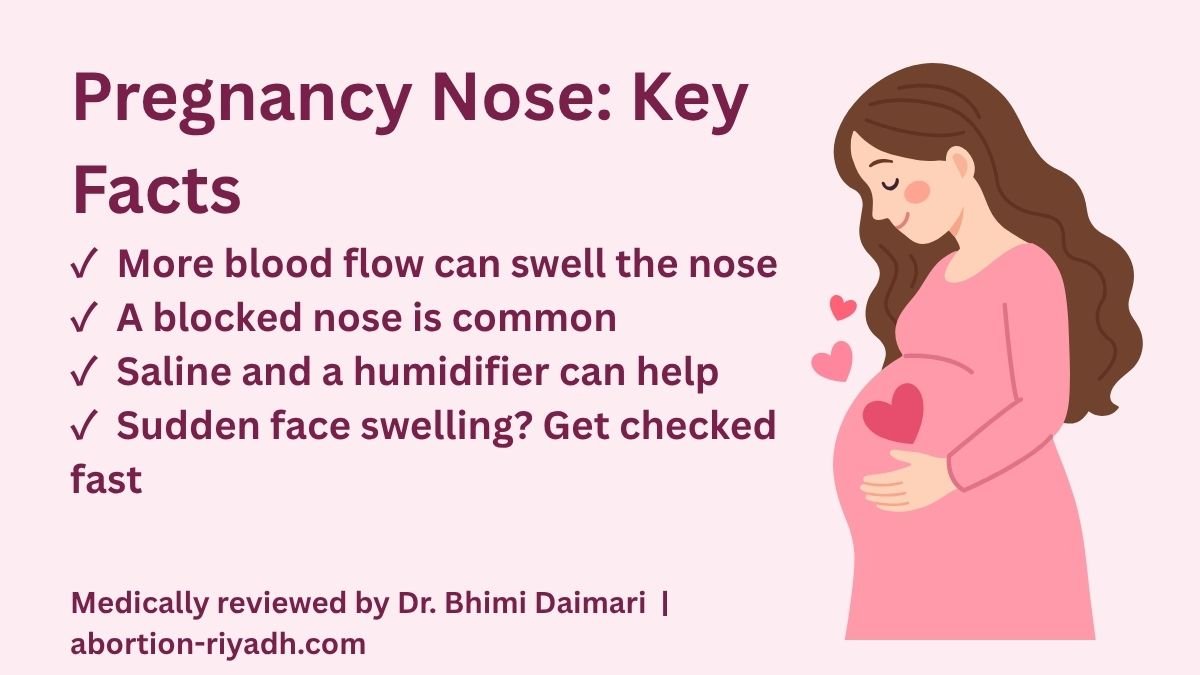
The amount of blood in your body increases through pregnancy and is close to half as much again by the third trimester. The nose has a dense network of small blood vessels, so extra blood flow shows there.
Hormones that relax blood vessels
Oestrogen rises steadily in pregnancy. It widens blood vessels and increases blood flow to mucous membranes, including the lining of the nose. Progesterone and hormones from the placenta add to the effect. Wider vessels leak a little more fluid into the tissue around them.
Fluid retention (oedema)
Your body holds on to more water in pregnancy. Most of it collects in the feet and ankles, but the hands and face share in it. Swelling is usually greater at the end of the day, in hot weather and in the last weeks.
The result is a nose that is slightly fuller on the outside and more congested on the inside. Lips, cheeks and gums can swell a little for the same reasons.
Pregnancy rhinitis: the blocked nose that is not a cold
Pregnancy rhinitis is nasal congestion that appears during pregnancy, lasts six weeks or longer, and has no other cause such as an infection or allergy. Studies suggest it affects roughly one in five pregnant women, though estimates vary.
Typical symptoms are:
- A blocked nose, often worse when you lie down.
- A watery, clear runny nose or mucus dripping down the back of the throat.
- Sneezing, without the itchy eyes of hay fever.
- Mouth breathing, snoring and broken sleep.
- A reduced sense of smell.
It is not contagious and does not cause fever, a sore throat or body aches. Smoking and existing allergies appear to make it more likely.
Tell your doctor if congestion is severe, if you snore loudly with pauses in your breathing, or if you wake unrefreshed. Poor sleep in pregnancy is worth treating.
Pregnancy rhinitis vs a cold, allergy or sinus infection
These conditions feel similar at first. The pattern over time usually separates them.
| Feature | Pregnancy rhinitis | Common cold | Allergy (hay fever) | Sinus infection |
|---|---|---|---|---|
| How long it lasts | Six weeks or more, until after birth | About one to two weeks | As long as the trigger is present | Often more than 10 days |
| Mucus | Clear and watery | Clear, then thicker | Clear and watery | Thick, yellow or green |
| Fever or body aches | No | Sometimes | No | Sometimes fever |
| Itchy eyes or nose | No | Rare | Yes, typical | No |
| Face pain or pressure | Mild fullness | Mild | Rare | Yes, often worse bending forward |
| What helps | Saline, humidity, raised head | Rest and fluids | Avoiding triggers; doctor-approved treatment | Medical assessment |
See a doctor if you have a fever, thick coloured mucus with face pain, or symptoms that get worse after the first week.
Nosebleeds in pregnancy
Nosebleeds are more frequent in pregnancy because the small vessels in the nose are wider, carry more blood and sit close to the surface. Blowing your nose hard, dry air or a minor knock can be enough to start one.
To stop a nosebleed:
- Sit down and lean slightly forward, not back.
- Pinch the soft part of your nose, just above the nostrils, firmly for 10 to 15 minutes without letting go.
- Breathe through your mouth and spit out any blood that runs into your throat.
- A cold pack on the bridge of the nose may help.
For the next day, avoid blowing or picking your nose, heavy lifting and very hot drinks. If you lie down afterwards, keep your head raised.
Get medical help if the bleeding has not stopped after 10 to 15 minutes of steady pressure, if it is very heavy, if you feel faint, or if nosebleeds keep returning. Frequent nosebleeds should also be mentioned at your antenatal visit so that your blood pressure and blood count can be checked.
When does pregnancy nose start, and when does it go away?
Congestion can begin at any stage, including the first trimester. Visible swelling of the nose is usually a feature of later pregnancy, when blood volume and fluid retention are at their highest. Many people notice it in the third trimester.
A stuffy nose is not a reliable early sign of pregnancy. If you are in the first days after conception and looking for clues, our guide to the first 72 hours of pregnancy symptoms explains what is realistic. To know for certain, see how to use a pregnancy test kit.
After the birth, hormone levels drop and your body clears the extra fluid through urine and sweat. Pregnancy rhinitis typically clears within about two weeks of delivery. The outside of the nose usually returns to its earlier shape within about six weeks, along with the swelling in your feet and hands.
It does not come back to stay. If it appeared in one pregnancy, it may or may not appear in the next.
Your nose is one of many parts of the body that change shape for a while. Read about when you start showing in pregnancy, and about the stretching pains that come with a growing uterus in our guides to round ligament pain and pelvic pain during pregnancy.
Safe ways to ease pregnancy nose and congestion
You cannot stop the nose from swelling, and you do not need to. These measures reduce congestion and help you sleep.
- Saline spray or rinse. Salt water thins mucus and soothes the lining of the nose. It contains no medicine and can be used as often as needed. If you use a rinse bottle or pot, make it up with sterile, distilled or boiled and cooled water.
- Humidifier. Moist air in the bedroom keeps the lining of the nose from drying out. Empty and clean the device as the manufacturer instructs so that mould does not grow in it.
- Elevation. Raise the head of the bed or use extra pillows so that your head and chest are higher than the rest of your body.
- Sleep on your side. This is the advised sleeping position in later pregnancy, and it often eases a blocked nose as well.
- Fluids. Drinking enough water keeps mucus thin.
- Gentle activity. A walk or other moderate exercise can open the nose for a while, if your doctor has not told you to limit activity.
- Adhesive nasal strips. Worn across the bridge of the nose at night, they hold the nostrils open and contain no medicine.
- Avoid irritants. Cigarette smoke, incense, strong perfumes and dust all make swelling worse.
- Protect the lining. Blow gently, one nostril at a time.
For puffiness in general, put your feet up when you can, avoid standing for long periods and keep cool in hot weather. Do not cut down on fluids. Drinking less does not reduce swelling.
What about medicines?
Do not start decongestant tablets, medicated nasal sprays or allergy medicines on your own. Some are not advised in parts of pregnancy or if your blood pressure is raised, and decongestant sprays can cause rebound congestion when used for more than a few days. Ask your doctor or pharmacist which options are suitable for your stage of pregnancy.
Red flags: when swelling is not just pregnancy nose
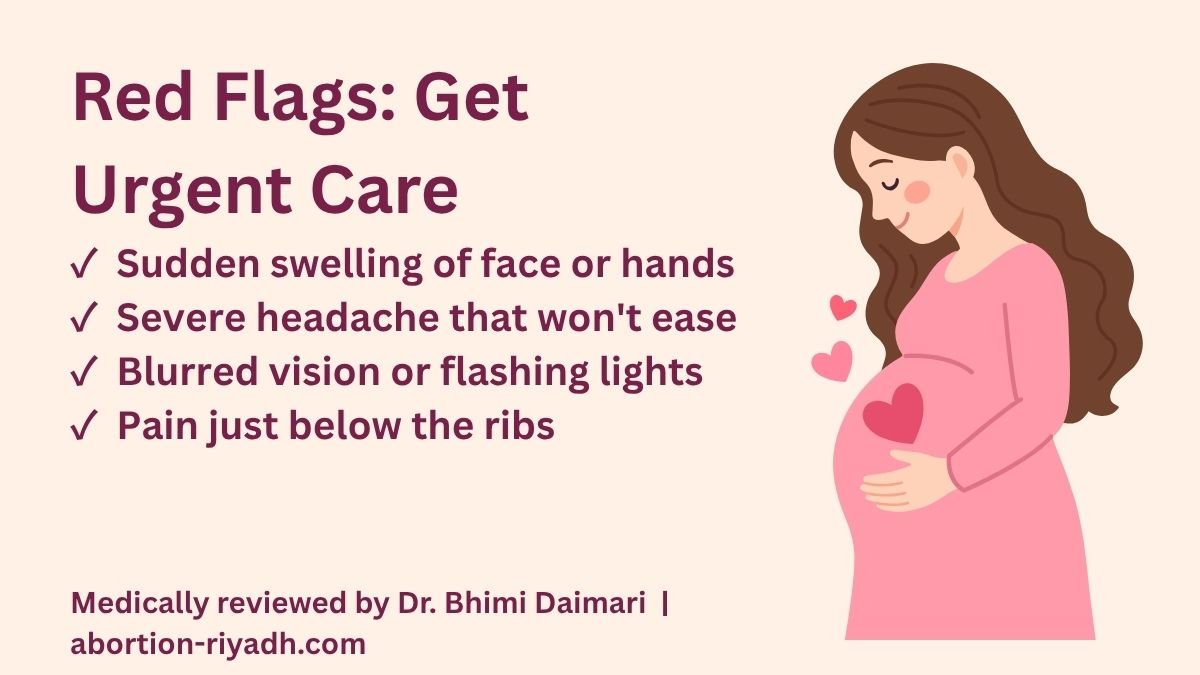
Normal pregnancy swelling builds slowly, is mild and changes through the day. Pre-eclampsia is a serious condition with high blood pressure that develops after 20 weeks of pregnancy, and sometimes in the days or weeks after birth. It can cause swelling that looks different: it comes on quickly and affects the face, the area around the eyes and the hands.
Seek urgent care if you have sudden swelling of your face, hands or feet together with any of these: a severe headache that does not ease, blurred vision, flashing lights or spots before your eyes, pain just below the ribs, vomiting, shortness of breath, or feeling very unwell. These can be signs of pre-eclampsia. Contact your maternity unit or go to an emergency department straight away, or call your local emergency number (997 in Saudi Arabia, 911 in the US).
Also arrange a prompt review if swelling is in one leg only with pain or redness, if your rings or shoes become tight within a day or two, or if you gain weight very quickly over a week.
Attend every antenatal appointment. Blood pressure and urine checks at these visits pick up pre-eclampsia before symptoms start, which is one reason a pregnancy that goes unnoticed, as in a cryptic pregnancy, carries extra risk.
Frequently Asked Questions
Does everyone get pregnancy nose?
No. Many people see no change in their nose at all, and others notice only mild puffiness late in pregnancy. Nobody can predict who will get it, and it says nothing about the health of your pregnancy.
Will my nose go back to normal after pregnancy?
Yes, in nearly all cases. As your body sheds the extra fluid and hormone levels fall, the swelling settles, usually within about six weeks of the birth. If your nose still looks different months later, mention it to your doctor.
Is a stuffy nose an early sign of pregnancy?
Some people do notice congestion in the first trimester, but it is far more often caused by a cold or allergy. A blocked nose alone cannot tell you that you are pregnant. A pregnancy test from the day of your missed period can.
Does pregnancy nose mean I am having a boy or a girl?
No. This is a popular belief with no scientific support. Nose swelling depends on your hormones, fluid balance and blood flow, not on the sex of your baby.
Can I use a nasal decongestant spray while pregnant?
Ask your doctor or pharmacist first. Some decongestants are not advised at certain stages of pregnancy or with high blood pressure, and sprays can make congestion worse if used for more than a few days. Saline spray is a safe starting point.
Why is my nose so blocked at night during pregnancy?
Lying flat lets more blood pool in the lining of the nose, so the swelling increases. Dry bedroom air adds to it. Raising your head and upper body and running a clean humidifier often help.
Are nosebleeds in pregnancy dangerous?
Most are short and harmless, even when they look dramatic. Get medical help if a nosebleed lasts longer than about 10 to 15 minutes, is very heavy, or keeps coming back. Tell your doctor too if you have high blood pressure or bruise easily.
Can pregnancy rhinitis affect my baby?
Congestion itself does not harm the baby. Poor sleep and heavy snoring can leave you exhausted, and loud snoring with pauses in breathing should be assessed. Mention severe or long-lasting symptoms at your antenatal visit.
Does swelling in my nose mean I have pre-eclampsia?
Not on its own. Gradual, mild puffiness of the nose is a normal pregnancy change. Pre-eclampsia causes sudden swelling of the face, hands or feet, usually with high blood pressure, headache or vision problems, and needs same-day assessment.
Related guides
- When do you start showing in pregnancy?
- Round ligament pain in pregnancy
- Pelvic pain during pregnancy
- Cryptic pregnancy: signs and causes
- Is diarrhea a sign of pregnancy?
- First 72 hours of pregnancy symptoms
Sources
- Cleveland Clinic – Pregnancy Rhinitis
- NHS – Nosebleeds in pregnancy
- NHS – Swollen ankles, feet and fingers in pregnancy
- ACOG – Preeclampsia and High Blood Pressure During Pregnancy
- NHS – Pre-eclampsia
- MedlinePlus – Stuffy or runny nose – adult
This page is general health information and does not replace advice from your own doctor. In an emergency, call your local emergency number (997 in Saudi Arabia, 911 in the US).