
Medically reviewed by Dr. Bhimi Daimari, MBBS, MS (Obstetrics and Gynaecology) · Review date: 14 November 2026
A sudden stab low in your belly when you stand up or sneeze can be alarming. In the second trimester it is very often round ligament pain. Here is how to recognise it, ease it and tell it apart from pain that needs attention.
Quick answer: Round ligament pain is a sharp, brief pain in the lower belly or groin caused by ligaments stretching as the uterus grows. It is harmless and eases with rest. Pain that is constant, severe or comes with bleeding or fever needs a doctor.
What is round ligament pain?
Round ligament pain is a sharp, brief pain or a dull ache low in the belly or groin, caused by the stretching of two ligaments that support the uterus. It is one of the most common discomforts of pregnancy and it is harmless for you and your baby.
You have two round ligaments, one on each side. Each is a cord of tissue that starts at the upper corner of the uterus, runs forward and down through the groin, and ends in the tissue of the outer lips of the vulva. Together they help hold the uterus tilted forward in the pelvis.
Before pregnancy these ligaments are short and firm. As the uterus grows, they get longer and thicker and are held under more tension, a little like a rubber band being pulled. A stretched ligament tightens slowly and relaxes slowly. When you move suddenly, it is pulled faster than it can adapt, and the nerves around it send a quick jolt of pain.
When does round ligament pain start?
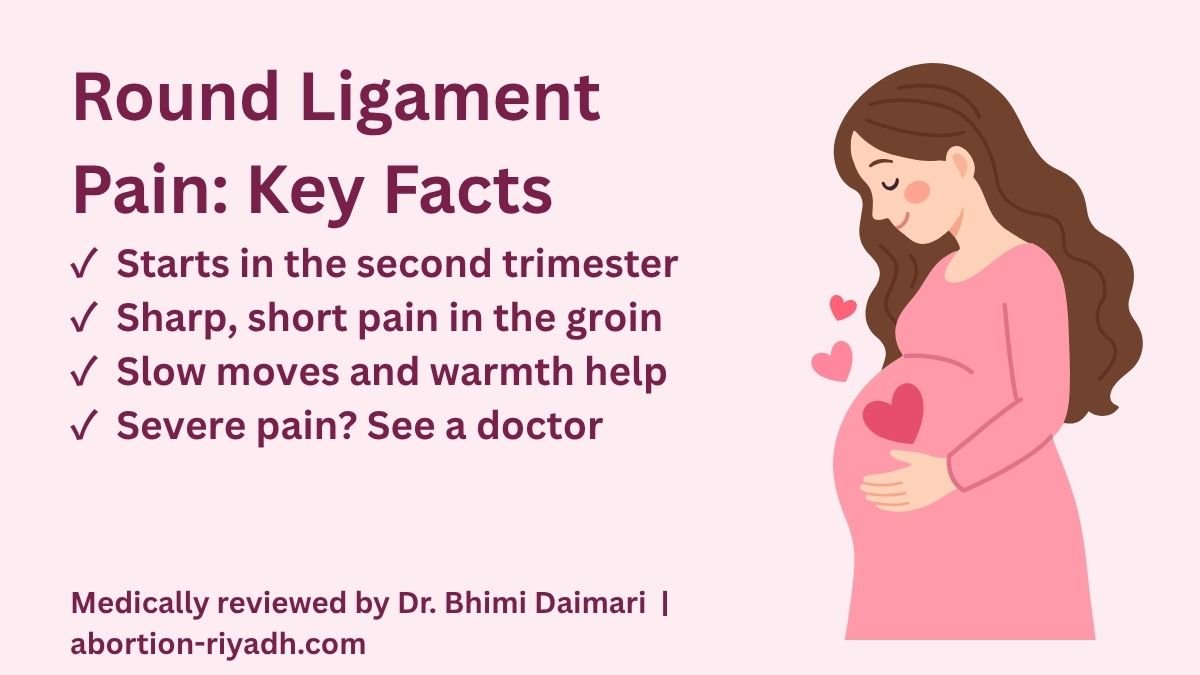
For most people it begins in the second trimester, from around week 14 onwards. This is when the uterus rises out of the pelvis and starts to grow quickly, which is also about the time your bump starts to show.
Some notice it a little earlier, late in the first trimester, especially in a second or later pregnancy. It can also carry on into the third trimester. Many people find it comes in phases, often during a growth spurt, and then fades for a while.
Pain low in the belly in the first weeks of pregnancy is usually something else, most often the mild cramps of early pregnancy. Round ligament pain goes away after the birth, when the uterus shrinks and the ligaments shorten again.
What does round ligament pain feel like?
People describe it in a few typical ways:
- a sudden sharp, stabbing or pulling pain low on one side of the belly, or in the groin;
- a jolt that lasts a few seconds, sometimes a minute or two, and then goes;
- a dull ache in the lower belly or hips after a long, active day;
- pain that can travel down into the groin or the top of the thigh.
It is felt more often on the right side, because the growing uterus tends to turn slightly to the right. It can also be on the left or on both sides.
The key features are that it is linked to movement, it is short, and it settles when you rest or change position. You feel well in between. There is no fever, no bleeding and no burning when you pee.
What triggers it?
Anything that tugs the ligament quickly can set it off:
- standing up fast from a chair or getting out of the car;
- rolling over in bed;
- coughing, sneezing or laughing;
- a sudden twist or reach;
- brisk walking, running or exercise with quick changes of direction;
- a long day on your feet.
The pain is not a sign that you have damaged anything. The ligament and the uterus are doing what they are meant to do.
How to relieve round ligament pain
You cannot stop the ligaments from stretching, but you can make the pain come less often and pass more quickly.
- Move slowly: change position in stages. To get out of bed, roll onto your side first, then push up with your arms.
- Brace before a cough or sneeze: bend forward a little at the hips and bring your knees up slightly, or put a hand under your bump. This takes the pull off the ligaments.
- Change position when it hits: stop, lean gently towards the sore side or sit down. Lying on your side with your knees bent and a pillow between them, and another under the bump, often eases it within minutes.
- Use warmth: a warm (not hot) bath or shower, or a warm pack over the sore area for a short time, relaxes the muscles. Avoid very hot baths, saunas and hot tubs in pregnancy.
- Try a support belt: a maternity belt or belly band lifts some of the weight of the bump. It helps most during walking and long periods of standing.
- Stretch gently: on your hands and knees, slowly round your back up and let it return to flat (the cat stretch), or do slow pelvic tilts. Prenatal yoga and swimming are good options. Stop any movement that makes the pain sharper.
- Pace your day: break up long spells of standing or walking with short rests, and keep active in a steady way.
Most people need nothing more than this. If the pain is troubling you a lot, ask your doctor which pain relief is suitable for you in pregnancy and how to take it. Do not take anti-inflammatory painkillers or any other medicine without that advice.
A physiotherapist who works with pregnant women can show you safe exercises and fit a support belt properly if the pain keeps limiting what you can do.
Round ligament pain vs other causes of pain
Because round ligament pain is so common, it is tempting to blame every ache on it. Most of the time that is right. Now and then, pain in the lower belly is a sign of a condition that needs treatment. The pattern of the pain and what comes with it are the best clues.
| Cause | How the pain behaves | What else you may notice | What to do |
|---|---|---|---|
| Round ligament pain | Sharp and brief on one or both sides, set off by movement, eases with rest | Nothing else; you feel well | Self-care; mention it at your next visit |
| Urinary tract infection | Ache or pressure low in the middle, above the pubic bone | Burning when you pee, peeing often, cloudy or smelly urine, sometimes fever or back pain | See a doctor soon for a urine test |
| Appendicitis | Constant pain that gets worse over hours, usually on the right; may sit higher than usual in later pregnancy | Nausea, vomiting, loss of appetite, fever | Emergency assessment |
| Placental abruption | Sudden, constant, severe pain; the uterus feels hard and tender | Vaginal bleeding (not always), back pain, baby moving less | Emergency assessment |
| Preterm labour | Tightenings or cramps that come at regular intervals before 37 weeks | Low backache, pelvic pressure, a change in discharge, fluid leaking | Contact your maternity unit straight away |
| Ectopic pregnancy (early weeks) | One-sided low belly pain that persists or worsens | Vaginal bleeding, shoulder-tip pain, dizziness or fainting | Emergency assessment |
Two points are worth adding. An ectopic pregnancy shows up in the first trimester, usually between weeks 4 and 12, before round ligament pain normally starts. If you have a positive test and one-sided pain before your first scan has shown where the pregnancy is, get checked. Our page on pregnancy of unknown location explains how doctors work this out.
Pain is also not always from the uterus. Constipation and trapped gas cause cramping that eases after you open your bowels. Pain centred over the pubic bone, hips or lower back that gets worse with walking or stairs may be pelvic girdle pain, which we cover in pelvic pain during pregnancy.
When to call your doctor
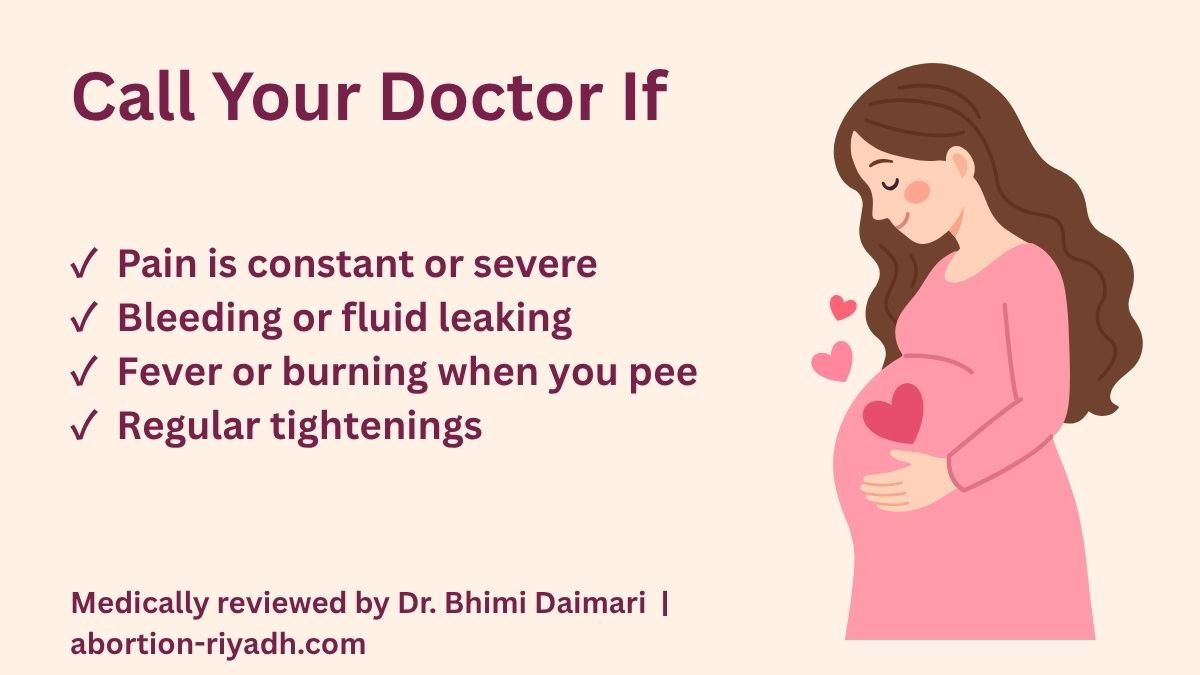
Round ligament pain should be short and should improve with rest. Pain that does not fit that pattern deserves a call, even if it turns out to be nothing.
Go to an emergency department or call your local emergency number (997 in Saudi Arabia, 911 in the US) if you have: severe pain, or pain that does not ease after resting for 30 to 60 minutes; vaginal bleeding or a gush or trickle of fluid; regular tightenings or cramps before 37 weeks; a fever or chills; pain or burning when you pee; vomiting with the pain; a hard, tender uterus; your baby moving less than usual; or dizziness, fainting or shoulder-tip pain.
Book a routine appointment if the pain is mild but keeps coming back on most days, stops you sleeping or walking comfortably, or you are simply not sure what you are feeling. Your doctor can examine you, test your urine and arrange an ultrasound if needed.
If you see any bleeding, compare it with our guides on how much bleeding is normal in early pregnancy and the signs of a miscarriage, and contact your doctor the same day.
Frequently Asked Questions
How long does round ligament pain last?
A single episode usually lasts a few seconds to a couple of minutes. The phase of getting these pains can come and go over several weeks, mostly in the second trimester. Pain that stays constant for more than an hour is not typical and should be checked.
Can you get round ligament pain in the first trimester?
It is less usual, but some people feel it from around weeks 10 to 12, particularly if they have been pregnant before. One-sided pain earlier than that should not be assumed to be round ligament pain. See a doctor to rule out an ectopic pregnancy if you have not yet had a scan.
Is round ligament pain on one side or both sides?
It can be either. The right side is more common because the uterus tends to rotate slightly to the right as it grows. Pain on the left or on both sides is also normal.
Does round ligament pain mean the baby is growing?
It means the uterus is growing and the ligaments are stretching to keep up. It does not tell you anything specific about the size or health of your baby. Not feeling it is just as normal.
Can round ligament pain hurt the baby?
No. The pain comes from the ligaments and the nerves around them, outside the uterus. Your baby is cushioned by fluid and is not affected.
How should I sleep to ease round ligament pain?
Lie on your side with your knees bent, one pillow between your knees and another under your bump. When you turn over, keep your knees together and move slowly. Many people find this stops the night-time jolts.
Is it safe to exercise with round ligament pain?
Yes, gentle activity such as walking, swimming and prenatal yoga is safe and often helps. Warm up first and avoid sudden twists or quick changes of direction. Stop and rest if a movement brings on sharp pain.
What is the difference between round ligament pain and contractions?
Round ligament pain is a quick stab linked to movement, usually on one side, and it settles with rest. Contractions make the whole uterus tighten and harden, come in a pattern, and do not stop when you change position. Regular tightenings before 37 weeks need urgent advice.
Is round ligament pain worse in a second pregnancy?
Many people say it starts earlier or feels stronger in later pregnancies. The ligaments and abdominal muscles have been stretched before, so the uterus moves forward sooner. It is still harmless and the same relief measures work.
Related guides
- Pelvic pain during pregnancy (SPD and pelvic girdle pain)
- When do you start showing in pregnancy?
- Early pregnancy cramps
- Pregnancy nose
- Is diarrhea a sign of pregnancy?
- Signs of a miscarriage
Sources
- Cleveland Clinic – Round ligament pain
- NHS – Stomach pain in pregnancy
- ACOG – Preterm Labor and Birth
- ACOG – Bleeding During Pregnancy
- ACOG – Ectopic Pregnancy
- MedlinePlus – Aches and pains during pregnancy
This page is general health information and does not replace advice from your own doctor. In an emergency, call your local emergency number (997 in Saudi Arabia, 911 in the US).