
Medically reviewed by Dr. Bhimi Daimari, MBBS, MS (Obstetrics and Gynaecology) · Review date: 14 November 2026
Some bumps appear at 12 weeks and others are barely visible at 20. Both can be completely healthy. This guide explains the usual timing, why it varies so much, and how doctors really judge your baby’s growth.
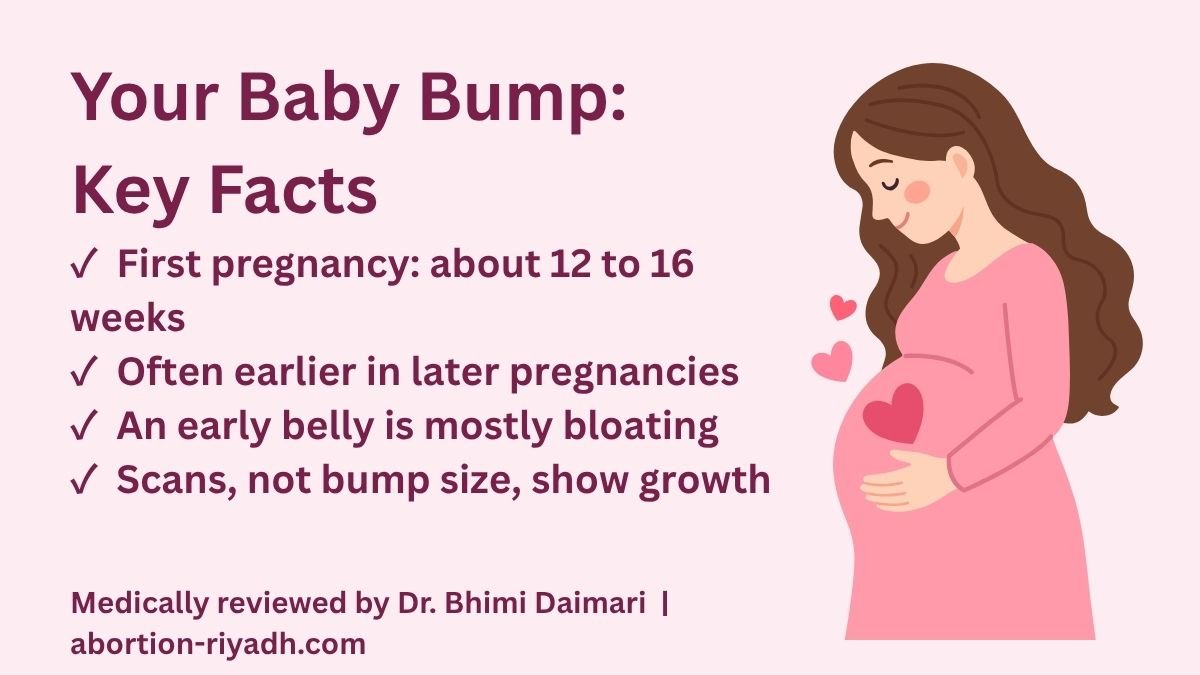
Quick answer: In a first pregnancy, a bump usually appears between 12 and 16 weeks, and often earlier in later pregnancies. Before 12 weeks, a bigger belly is mostly bloating. Bump size does not tell you how well your baby is growing.
When do you start showing in pregnancy?
In a first pregnancy, most people start to show between about 12 and 16 weeks. If you have been pregnant before, you may notice a bump a few weeks sooner. Some people do not look pregnant to others until 20 weeks or later, and that is normal too.
The reason is simple anatomy. For the first 12 weeks the uterus sits low in the pelvis, behind the pubic bone. At around 12 weeks it is roughly the size of a grapefruit and its top edge rises just above the bone. From then on it grows upward and forward into the belly, where there is room for it to be seen.
“Showing” also means different things. You will usually notice a firmer, rounder lower belly and tighter waistbands a few weeks before anyone else can tell. A bump that is obvious to strangers often arrives closer to weeks 18 to 22.
The timing of your bump says nothing about how healthy the pregnancy is. Your doctor checks your baby’s growth by ultrasound and, later, by measuring your belly, not by how you look in the mirror.
Why you may show earlier the second time
Many people are surprised to need maternity clothes weeks earlier in a second or third pregnancy. The baby is not growing faster. The difference is in your body.
The abdominal muscles and the tissue between them have been stretched before, so they hold the uterus less tightly and let it tip forward sooner. The uterus itself may also not return to quite its original size after a first pregnancy. You know what a bump feels like as well, so you recognise it earlier.
The same stretching explains why the ligaments that support the uterus can ache sooner. If you get quick, sharp twinges low in the belly as the bump appears, read about round ligament pain in pregnancy.
What affects when your bump appears
Two healthy people at the same week can look very different. These are the main reasons:
- First or later pregnancy: as described above, later pregnancies tend to show earlier.
- Position of the uterus: most uteruses tilt forward. About one in five tilts backward, towards the spine (a retroverted uterus). A backward tilt can hide the bump for longer in the first months. The uterus usually moves forward on its own as it grows out of the pelvis.
- Height and length of the torso: if you are tall or long in the body, the uterus has more room to grow upward, so the bump may look smaller and appear later. In a shorter torso it has to push outward sooner.
- Abdominal muscle tone: strong, tight core muscles hold the uterus in for longer. Muscles that are more relaxed, or separated from a previous pregnancy, allow it forward earlier.
- Body weight and shape: with more tissue around the middle, a bump may blend in for longer before it takes a clear rounded shape. With very little, small changes are visible early.
- Twins or more: the uterus grows faster with more than one baby, and many people carrying twins show by the end of the first trimester.
- Bloating: gas and constipation can make the belly look bigger from the first weeks, long before the uterus is large enough to show.
- Fibroids or extra fluid: large fibroids or a higher than usual amount of amniotic fluid can make the belly bigger than expected for the week.
- Your dates: if ovulation happened later than you thought, you may simply be less far along. An early ultrasound gives the most accurate dating.
Bloating or a real bump?
In the first trimester, the belly you see is mostly bloating. The hormone progesterone relaxes the muscle of the bowel, digestion slows down, and gas builds up. Many people cannot do up their jeans at 7 or 8 weeks, when the uterus is still tucked inside the pelvis.
You can usually tell the two apart:
- Bloating changes through the day. It is flatter in the morning and bigger by evening or after meals. It feels soft, and it eases after passing gas or opening your bowels.
- A true bump stays. It is there when you wake up, it feels firm low down above the pubic bone, and it rises a little higher every couple of weeks.
Small, frequent meals, plenty of water, fibre and a daily walk help with bloating. They will not change the bump, which grows on its own timetable.
Bump size by trimester
Doctors track where the top of the uterus (the fundus) can be felt. The landmarks below are averages, and a healthy uterus may sit a little higher or lower.
| Stage | Where the top of the uterus is | What you may see |
|---|---|---|
| Weeks 1–11 (first trimester) | Inside the pelvis, behind the pubic bone | No true bump; any roundness is mostly bloating |
| Weeks 12–16 | Just above the pubic bone, rising to about halfway to the navel | A small, firm curve low in the belly; clothes feel tight |
| Weeks 17–20 | Reaches the level of the navel at around week 20 | A clear bump for most people; others begin to notice |
| Weeks 21–27 (late second trimester) | Above the navel, rising by about a centimetre a week | A rounded bump; the navel may flatten or pop out |
| Weeks 28–36 (third trimester) | Climbs to just under the ribs by around week 36 | A large bump; you may feel short of breath or get heartburn |
| Weeks 37–40 | May drop a little as the baby settles into the pelvis | The bump looks lower; breathing eases and pelvic pressure increases |
As the bump grows, the rest of the body changes too. Blood volume and fluid increase, which is why the face and nose can look fuller late in pregnancy, as we explain in pregnancy nose. The extra weight in front also loads the pelvic joints. If you develop pain over the pubic bone or hips, see our guide to pelvic pain during pregnancy.
What “measuring big” or “measuring small” means
From around 24 weeks, your doctor or midwife may measure your fundal height at each visit. This is the distance in centimetres from the top of your pubic bone to the top of your uterus, taken with a tape measure while you lie back.
As a rule of thumb, the number in centimetres is close to the number of weeks you are pregnant, give or take about two centimetres. At 30 weeks, for example, a measurement between about 28 and 32 centimetres is in the expected range. What matters most is steady growth from one visit to the next.
Measuring big (large for dates) can be due to:
- dates that are slightly out;
- twins or more;
- a baby who is larger than average, which is sometimes linked to diabetes in pregnancy;
- more amniotic fluid than usual;
- fibroids, or the baby lying in a breech or sideways position.
Measuring small (small for dates) can be due to:
- dates that are slightly out;
- a baby who is naturally small, or one who is not growing as expected;
- less amniotic fluid than usual;
- the baby having dropped low into the pelvis near term;
- your own build, such as being petite or having firm abdominal muscles.
Fundal height is a screening tool. It is less accurate if you have a higher body weight, fibroids or a multiple pregnancy, and the result can vary with a full bladder or with the person holding the tape. A measurement outside the expected range does not mean something is wrong. It means your doctor will usually arrange an ultrasound to check the baby’s size, the fluid and the placenta.
When to talk to your doctor
Not showing at 16 or even 20 weeks is rarely a concern if your scans and check-ups are normal. Raise it at your next visit if you are worried, so your doctor can examine you and reassure you.
A belly that is much larger than expected in the first trimester is usually bloating or a sign of twins. Rarely, a uterus that is large for dates together with bleeding and severe nausea can point to a molar pregnancy, which is diagnosed by ultrasound and blood tests. If you have not had a scan yet, hCG levels by week explains what blood results can and cannot show.
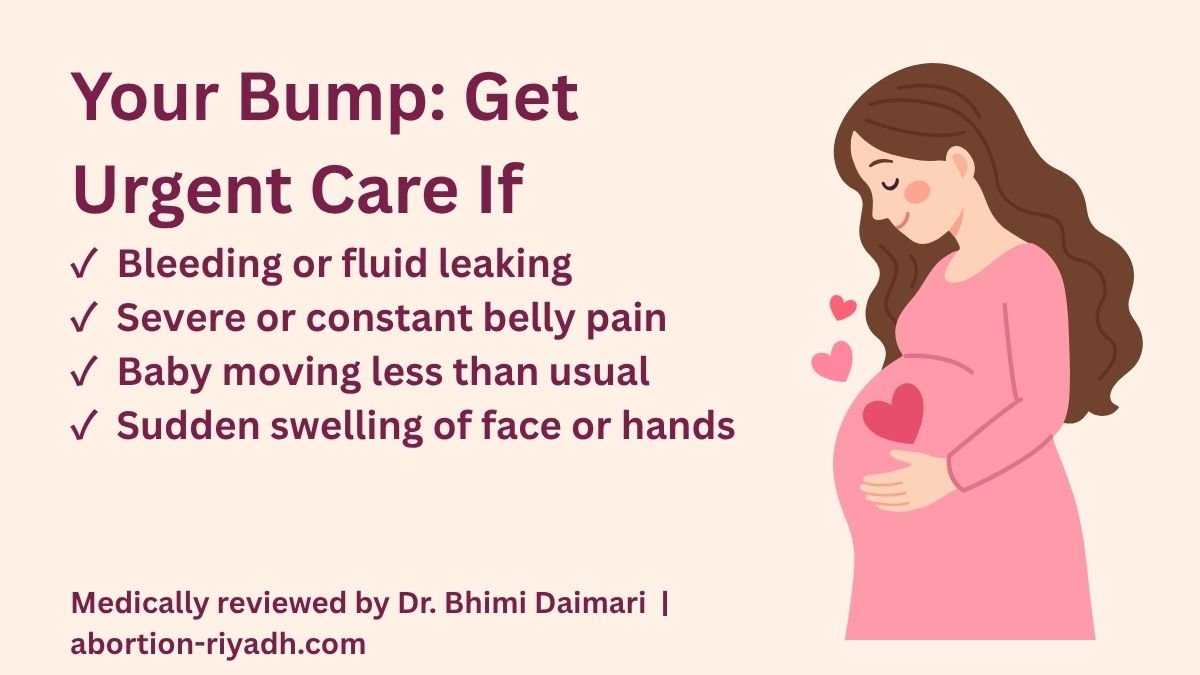
Seek urgent care or call your local emergency number (997 in Saudi Arabia, 911 in the US) if you have: vaginal bleeding or fluid leaking; severe or constant belly pain; a bump that becomes hard and painful; your baby moving less than usual after you have started to feel regular movements; or sudden swelling of the face and hands with a bad headache or changes in your vision. These are not about bump size and should not wait for a routine appointment.
A small number of people do not show much at all, or do not realise they are pregnant until late. If that interests you, read our article on cryptic pregnancy.
Frequently Asked Questions
Can you start showing at 8 weeks?
A true bump at 8 weeks is unlikely in a single pregnancy, because the uterus is still inside the pelvis. What you see is nearly always bloating from slower digestion. Showing this early is a little more plausible with twins or in a later pregnancy.
Is it normal to not be showing at 20 weeks?
Yes, it can be. Tall people, those with strong abdominal muscles, a backward-tilted uterus or a higher body weight often show later. If your 20-week scan and check-ups are normal, a small bump is not a concern.
Do you show earlier with twins?
Usually, yes. The uterus grows faster with two babies, and many people carrying twins have a visible bump by the end of the first trimester. Their fundal height also runs ahead of their weeks later on.
Does a small bump mean a small baby?
Not necessarily. Bump size depends on your build, your muscles, the baby’s position and the amount of fluid as much as on the baby. If your fundal height measures small, your doctor will arrange an ultrasound to check.
Why does my bump look bigger at night?
Bloating builds up through the day as you eat and drink, and tired abdominal muscles relax and let the belly push forward. The uterus itself has not changed size since the morning. This is most noticeable in the first half of pregnancy.
Does a tilted uterus make you show later?
It can for the first few months, because a uterus that tilts backward grows towards the spine at first. By around 12 to 14 weeks it usually lifts forward, and the bump then catches up. A tilted uterus does not harm the pregnancy.
When will other people notice I am pregnant?
For a first pregnancy, most people find that others notice between about 18 and 22 weeks. Loose clothing can hide a bump for longer, and fitted clothing shows it sooner. You will usually see the change yourself several weeks earlier.
Can I do anything to show sooner or later?
No. The timing depends on your anatomy and your baby’s growth, not on anything you do. Eating more will add weight but will not make the uterus grow faster, and dieting or tight binding to hide a bump is not safe in pregnancy.
When does the belly button pop out in pregnancy?
If it happens, it is usually in the late second or the third trimester, as the uterus presses forward behind the navel. Not everyone gets it. It goes back after the birth in most people.
Related guides
- Round ligament pain in pregnancy
- Pelvic pain during pregnancy (SPD and pelvic girdle pain)
- Cryptic pregnancy
- Pregnancy nose
- hCG levels by week
- Early pregnancy cramps
Sources
- Cleveland Clinic – Fundal height
- Mayo Clinic – What is a fundal height measurement? Why does it matter?
- ACOG – How Your Fetus Grows During Pregnancy
- NHS – You and your baby at 12 weeks pregnant
- NHS – You and your baby at 16 weeks pregnant
This page is general health information and does not replace advice from your own doctor. In an emergency, call your local emergency number (997 in Saudi Arabia, 911 in the US).