

Medically reviewed by Dr. Bhimi Daimari, MBBS, MS (Obstetrics and Gynaecology) · Review date: 11 November 2026
Seeing blood when you are pregnant is frightening, and many women fear the worst straight away. But bleeding and cramps are common in the first weeks, and many of these pregnancies carry on normally.
This guide explains the signs of a miscarriage, how they change from week 4 to the later weeks, which signs need a doctor today, and which need an ambulance.
Quick answer: The main signs of a miscarriage are vaginal bleeding, cramping pain low in the tummy or back, passing clots or tissue, and pregnancy symptoms that suddenly fade. None of these proves a miscarriage on its own, and some miscarriages cause no signs at all. Only an ultrasound scan, sometimes with repeat hCG blood tests, can confirm it. Heavy bleeding, severe pain or fainting need emergency care.
What is a miscarriage?
A miscarriage is the loss of a pregnancy before the 20th week (doctors in the UK count up to 24 weeks). Most happen in the first 12 weeks. It is far more common than people think: about 10 to 20 in every 100 known pregnancies end this way, and the risk of miscarriage falls week by week as the pregnancy grows.
The main signs of a miscarriage
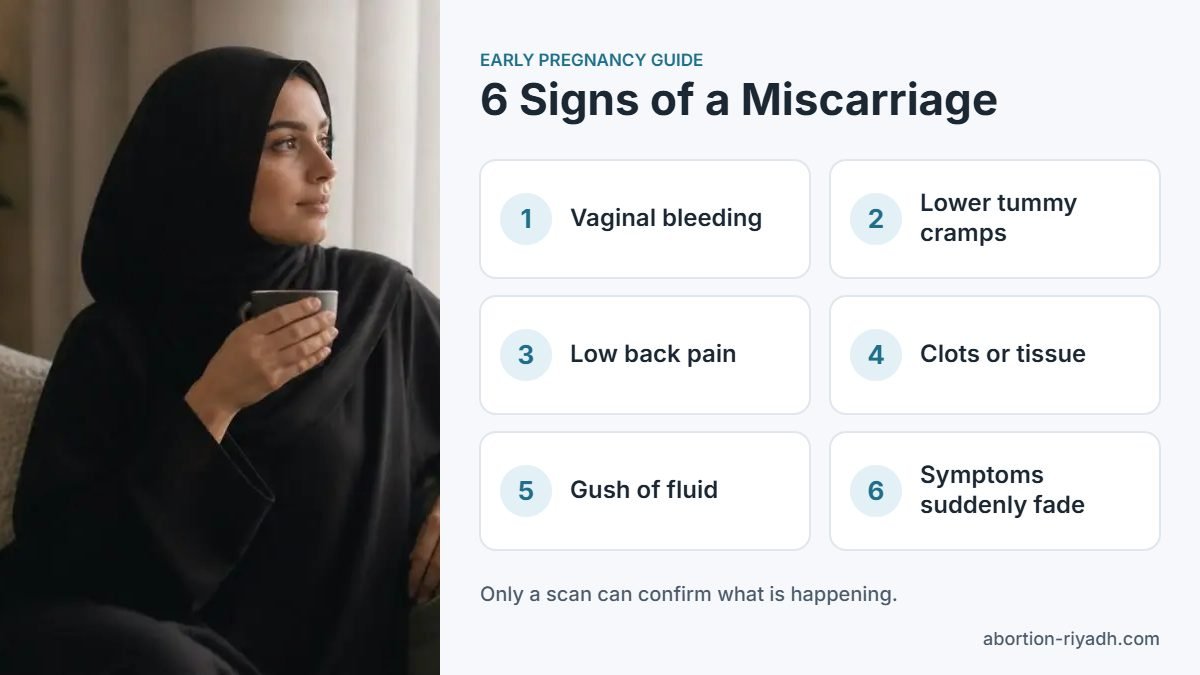
- Vaginal bleeding. This is the most common sign. It may start as brown or pink spotting and become bright red, heavier, and mixed with clots. Bleeding that keeps getting heavier is more worrying than spotting that settles.
- Cramps in the lower tummy. The pain is often stronger than period pain and may come in waves.
- Low back pain. A dull ache that can be mild or strong.
- Passing clots or tissue. The tissue may look pink, grey or white. Our guide on what a miscarriage looks like describes this in more detail.
- A gush of clear or pink fluid from the vagina.
- Pregnancy symptoms that stop suddenly. Sore breasts and nausea may fade within a day or two.
Having these signs does not confirm a loss. It means you need to be checked.
Bleeding and cramps do not always mean miscarriage
Bleeding in the first 12 weeks is common, and many women who have it go on to have a healthy baby. Light spotting can come from the pregnancy settling into the womb lining, or from the cervix, which bleeds easily in pregnancy, for example after intercourse. You can read more about how much bleeding is normal in early pregnancy.
Mild pulling or stretching pains are also expected as the womb grows. See our page on early pregnancy cramps for what is usual and what is not.
When there is bleeding but the scan still shows a heartbeat and the cervix is closed, doctors call it a threatened miscarriage. Many of these pregnancies continue.
Signs of a miscarriage by week
Around 4 to 5 weeks
A very early loss often feels like a period that came a few days late. The bleeding may be a little heavier than usual, with more cramps and small clots. A pregnancy test that was positive may become faint and then negative.
From 6 to 12 weeks
The signs are usually clearer. Bleeding is heavier than a period and often has clots. Cramps are stronger and come in waves, and you may pass tissue. Some women notice that nausea and breast soreness have gone before the bleeding starts.
After 12 weeks
A later loss is less common. The pain can feel like labour, with strong, regular tightenings. There may be a sudden gush of fluid, heavy bleeding, or, later on, a baby who has stopped moving. Any of these needs a hospital visit straight away.
Missed miscarriage: when there are no signs
Sometimes the pregnancy stops growing, but the body gives no signal. There is no bleeding and no pain. This is called a missed or silent miscarriage, and it is usually found at a routine scan. Many women feel completely well.
This is hard news to receive when you had no warning. Our page on missed miscarriage explains what happens next.
How doctors confirm a miscarriage
You cannot confirm a miscarriage at home. Signs only raise the question. Your doctor will usually:
- ask about your bleeding, pain and the date of your last period;
- do an ultrasound scan, often through the vagina in early pregnancy, to look for the pregnancy sac and a heartbeat;
- check hCG levels with two blood tests about 48 hours apart, to see whether the hormone is rising or falling.
If the pregnancy is very early, one scan may not give a clear answer, and a repeat scan after one to two weeks is common. A home urine test does not help here, because it can stay positive for some weeks after a loss.
When to get urgent help

Some signs point to heavy blood loss, an infection, or an ectopic pregnancy (a pregnancy growing outside the womb, usually in a tube). An ectopic pregnancy can bleed inside the tummy and is an emergency.
Get urgent medical help (in Saudi Arabia call 997) if you have:
- heavy bleeding that soaks one to two large pads an hour for two hours in a row;
- severe tummy pain, especially on one side;
- pain at the tip of your shoulder;
- dizziness, fainting or a racing heartbeat;
- a fever of 38°C or higher, chills, or bad-smelling discharge.
Sign, what it can mean, and what to do
| Sign | What it can mean | What to do |
|---|---|---|
| Brown or pink spotting, no pain | Often harmless; sometimes an early warning | Call your doctor within 24 hours |
| Red bleeding with period-like cramps | Threatened miscarriage or the start of a miscarriage | See a doctor the same day for a scan |
| Clots or tissue with strong cramps | A miscarriage is likely happening | Go to hospital the same day |
| Pregnancy symptoms gone, no bleeding | Often normal; rarely a missed miscarriage | Book a check-up and scan |
| Soaking one to two large pads an hour for two hours | Heavy blood loss | Call 997 or go to emergency |
| One-sided pain, shoulder-tip pain, fainting | Possible ectopic pregnancy | Call 997 now |
| Fever of 38°C or higher, bad-smelling discharge | Possible infection in the womb | Go to emergency today |
What to do now if you think you are miscarrying
- Check the urgent list above first. If any sign fits, call 997 or go to the nearest emergency department. Do not drive yourself.
- If there are no emergency signs, call your doctor or maternity clinic today. For medical advice by phone, the Ministry of Health line is 937.
- Use sanitary pads, not tampons, and note how many you soak each hour.
- Write down when the bleeding started, how the pain feels, and the first day of your last period.
- If you pass tissue, tell the doctor. A photo can help.
- Ask a family member to stay with you.
- Do not take any medicine or herbal remedy to stop or speed up the bleeding unless your doctor advises it.
Looking after yourself after a loss
Almost every woman asks, “Did I do something wrong?” The answer is nearly always no. Most early losses happen because the pregnancy did not form properly from the start. Work, prayer positions, a small fall, stress or a cup of coffee do not cause them. Our article on what causes miscarriage explains why it is not your fault.
Sadness, anger and numbness are all normal, and they may last longer than the bleeding. Talk to your husband, your mother, a friend or your doctor. If the low mood does not lift after a few weeks, ask for help. Most women who have a miscarriage go on to have a healthy pregnancy later.
A loss that happens before a scan can show the pregnancy, often around the time a period is due, is called a chemical pregnancy.
Frequently Asked Questions
What are the early signs of a miscarriage?
The early signs are usually vaginal bleeding and cramping low in the tummy. Bleeding may start as brown or pink spotting and then turn red and heavier, sometimes with clots. Some women also notice a dull backache, or feel that breast soreness and nausea have suddenly gone. These signs can also happen in a healthy pregnancy, so they do not prove a loss. See a doctor for a scan to find out what is happening.
What are the signs of a miscarriage at 4 weeks and at 6 weeks?
At 4 weeks, a loss often looks like a period that comes a few days late and may be a little heavier or more crampy than usual. A pregnancy test that was positive may turn negative within days or weeks. At 6 weeks, the bleeding is usually heavier than a period, with clots and stronger cramps that come in waves. At either stage, a doctor needs to check you to be sure.
How do you know if you had a miscarriage without a test?
You cannot know for certain without a medical check. Heavy bleeding with clots, strong cramps and passing greyish or pink tissue after a positive pregnancy test strongly suggest a miscarriage. But the same signs can come from other problems, including an ectopic pregnancy, which is dangerous. A home pregnancy test cannot answer the question either, because it can stay positive for some weeks after a loss. A scan and blood tests give the real answer.
Are there signs of a missed miscarriage?
Often there are none. In a missed miscarriage the pregnancy has stopped growing, but the body has not yet started to bleed or cramp. Some women notice brownish discharge, or find that nausea and breast tenderness have faded earlier than expected. Many feel completely normal and only find out at a routine scan. Because the signs are so unreliable, an ultrasound scan is the only way to diagnose it.
Are there always signs of a miscarriage? Can you miscarry without bleeding?
No, there are not always signs, and a miscarriage can happen without any bleeding at first. This is called a missed or silent miscarriage, and it is found on an ultrasound scan. Bleeding usually starts later, sometimes days or weeks afterwards, or the doctor may offer treatment. This is one reason why early pregnancy scans and antenatal visits matter, even when you feel well and have no pain or bleeding at all.
Are there signs of miscarriage before bleeding starts?
Sometimes. A few women notice mild cramps, a low backache, brown discharge or a sudden drop in pregnancy symptoms before any red bleeding begins. Others notice nothing at all. These early clues are weak, because all of them also happen in pregnancies that go on normally. If something feels different and you are worried, it is reasonable to ask your doctor for a check rather than wait for bleeding.
Can cramps or brown spotting be a sign of miscarriage?
They can be, but often they are not. Mild cramps are common as the womb grows, and brown spotting is usually old blood leaving slowly. Be more concerned if the cramps become stronger than period pain, come in regular waves, or if the spotting turns red and gets heavier. Pain mainly on one side needs a same-day check, because it can be a sign of an ectopic pregnancy.
Can a heavy or early period be a sign of an early miscarriage?
An early period is usually just a period. A very early miscarriage more often looks like a late period, arriving a few days to a week after it was due, and sometimes heavier and with more clots than normal. Unless you had a positive pregnancy test before the bleeding, there is no way to tell the two apart afterwards. If heavy periods keep happening, see a gynaecologist to look for other causes.
Can losing pregnancy symptoms, such as nausea going away, be a sign of miscarriage?
It can be, but on its own it is not a reliable sign. Nausea, tiredness and breast soreness naturally rise and fall from day to day, and for most women they ease by around 12 to 14 weeks. A sudden loss of all symptoms in the first weeks, especially together with bleeding or cramps, is worth a check. If you have no bleeding or pain, mention it to your doctor at your next visit, or sooner if you feel anxious.
Sources
- NHS – Miscarriage: Symptoms
- NICE – Ectopic pregnancy and miscarriage: diagnosis and initial management (NG126)
- RCOG – Bleeding and/or pain in early pregnancy
- Mayo Clinic – Miscarriage: Symptoms and causes
- Cleveland Clinic – Miscarriage: Pregnancy Loss, Causes & Signs
Medical disclaimer: This article is for general education only. It does not replace advice, diagnosis or treatment from a qualified doctor. If you are bleeding heavily or in severe pain, go to the nearest emergency department.