

Key takeaways
- A missed abortion also called a missed miscarriage or silent miscarriage is when a pregnancy has stopped growing, but the body has not yet passed the pregnancy tissue.
- Most women have no bleeding or pain. It is usually found on a routine ultrasound.
- It is not caused by anything you did. Most early losses are due to chromosome problems in the pregnancy.
- There are 3 treatment options: waiting, medicine, or a short procedure.
- Most women can have a healthy pregnancy afterwards.
What is a missed abortion?
In medicine, “abortion” means any pregnancy that ends before about 20 weeks, including miscarriage. A missed abortion is a type of spontaneous abortion (miscarriage). The embryo or fetus has stopped developing, but it stays in the womb, the cervix stays closed, and there may be no symptoms at all.
It is one of the types of miscarriage explained in our guide to types of abortion. Unlike a threatened abortion (bleeding while the pregnancy is still alive) or an inevitable abortion (bleeding with an open cervix), a missed abortion is often “silent”.
Missed abortion symptoms
Many women feel completely normal. When there are signs, they may include:
- Pregnancy symptoms fading: less nausea, breasts no longer tender
- Light brown spotting or a brownish discharge
- Mild cramps (in some women)
- A feeling that “something is not right”
Losing pregnancy symptoms does not always mean a miscarriage, because symptoms often ease naturally after 10–12 weeks. Only an ultrasound can tell for sure. Learn more about what a miscarriage looks like.
How is a missed abortion diagnosed?
A doctor diagnoses a missed abortion with a transvaginal ultrasound, sometimes with blood tests for the pregnancy hormone (hCG). Doctors follow strict rules so that a healthy pregnancy is never wrongly diagnosed. Signs that confirm pregnancy loss include:
- An embryo measuring 7 mm or more with no heartbeat
- A pregnancy sac measuring 25 mm or more with no embryo
- No embryo with a heartbeat on a repeat scan some days later, when one should be visible
If the results are not clear, the doctor will usually repeat the scan in 7–14 days before making any decision. This is important. If your dates may be wrong, it is safer to wait and recheck.
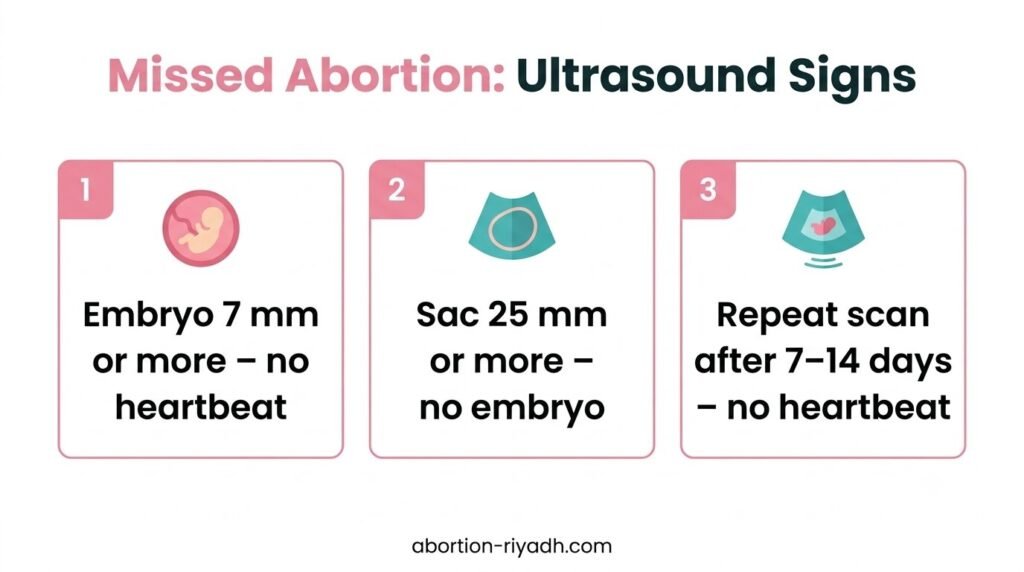
Source: ACOG – Early Pregnancy Loss and StatPearls – Early Pregnancy Loss.
What causes a missed abortion?
- Chromosome problems in the pregnancy: the most common cause, and they happen by chance
- Hormone problems, such as thyroid disease
- Uncontrolled diabetes
- Problems with the shape of the womb
- Clotting disorders, such as antiphospholipid syndrome
- Older age of the mother (the risk rises after 35)
What does NOT cause it: normal exercise, working, sex, a small fall, stress, or eating spicy food. Most women did nothing wrong.
Missed abortion treatment options
Once the diagnosis is confirmed, there are three options. All three are safe, and the right one depends on your health, how many weeks pregnant you are, and what you prefer.
Waiting (expectant management)
Some women prefer to let the body pass the tissue naturally. This can take days to a few weeks, and it does not always work in a missed abortion. Your doctor will plan a follow-up check.
Medicine (medical management)
Medicines help the womb contract and pass the tissue at home or in hospital, under a doctor’s care. Bleeding and cramps are expected for a few hours. A follow-up test or scan confirms that the womb is empty. Read more about how abortion medicines work and how painful it can be.
A short procedure (surgical management)
Vacuum aspiration gently removes the tissue in a clinic or hospital, usually under local anaesthetic or sedation. It is quick and gives a clear end point. See how an abortion procedure is done.
Table: treatment options compared
| Waiting | Medicine | Procedure | |
|---|---|---|---|
| Time | Days to weeks | Hours to days | About 10–15 minutes |
| Where | Home | Home or hospital | Clinic or hospital |
| Bleeding | Unpredictable | Heavy for some hours | Less |
| Follow-up | Needed | Needed | Usually simple |
Your doctor may also check your blood group, because some women need an extra injection after a pregnancy loss.
Possible complications
Complications are uncommon, but they can include:
- Incomplete miscarriage: some tissue stays behind. See incomplete abortion.
- Infection: fever, bad-smelling discharge or worsening pain
- Heavy bleeding
Go to the emergency department or call 997 if you have:
- bleeding that soaks 2 large pads an hour for 2 hours
- fever, chills or bad-smelling discharge
- severe pain, especially on one side
- dizziness or fainting
Recovery after a missed abortion
- Bleeding: usually lasts 1–2 weeks and gets lighter.
- Your period: often returns in 4–6 weeks. See period after abortion.
- Pregnancy test: may stay positive for a few weeks while hormones fall.
- Feelings: grief, sadness or guilt are normal, even when the loss was early. Read about emotional health after pregnancy loss.
Can I get pregnant after a missed abortion?
Yes. Most women go on to have a healthy pregnancy. You can usually try again once you feel physically and emotionally ready, and your doctor may suggest waiting for one normal period so dates are easier to track. If you have had 2 or more losses, ask your doctor about tests. Learn more about pregnancy after a loss.
Getting care in Saudi Arabia
If you are pregnant and have spotting, or your symptoms suddenly fade, see a gynaecologist at a Ministry of Health hospital or licensed clinic. Call 937 for medical advice, or 997 in an emergency. For more, read our complete medical guide.
Related: Want to know why it happens? Read what causes miscarriage – the common causes, risk factors and myths.
Another rare reason a pregnancy does not develop normally is a molar pregnancy – see its signs and how it is treated.
Frequently Asked Questions
What is a missed abortion?
It is a miscarriage where the pregnancy has stopped growing but the tissue has not yet left the womb. There is often no bleeding or pain.
What are the symptoms of a missed miscarriage?
Often none. Some women notice pregnancy symptoms fading, light brown spotting or mild cramps.
How is a missed abortion confirmed?
With a transvaginal ultrasound, sometimes repeated after 7–14 days, plus hCG blood tests if needed.
How long can a missed miscarriage stay in the body?
It can stay for days or several weeks before the body passes it naturally. That is why many women choose medicine or a procedure.
Is a missed abortion my fault?
No. Most are caused by chromosome problems that happen by chance.
Can I get pregnant after a missed abortion?
Yes. Most women have a healthy pregnancy afterwards. Ask your doctor when it is right for you to try again.
References
Author box: Medically reviewed by Dr. Bhimi Daimari, MBBS, MS (Obstetrics & Gynaecology) · Review date: 1 November 2026 · Reg. No. 23218 · Published: November 2026
Medical disclaimer: This article is for general education only and is not a substitute for advice from a qualified doctor. If you have heavy bleeding, severe pain or fever, call 997